
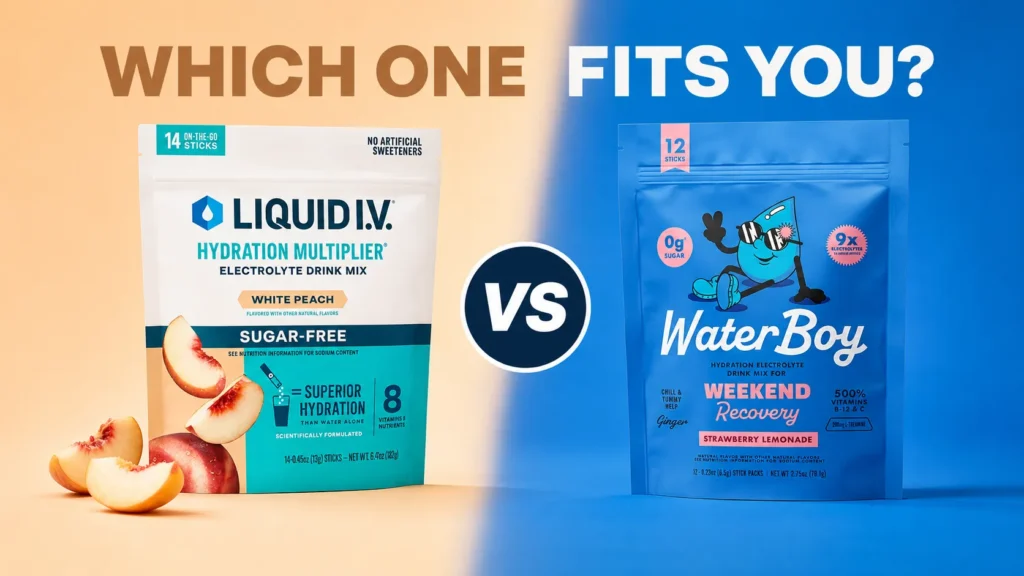
In the Liquid IV vs Waterboy comparison, Liquid I.V. Hydration Multiplier Lemon Lime offers a glucose-containing formula designed for 16 ounces of water and is widely available. Waterboy Daily Hydration is sugar-free and makes a more concentrated 8- to 12-ounce drink. Neither is universally better, so compare sodium, carbohydrates, serving volume, sweeteners, and price before choosing.
Table of Contents
Liquid IV vs Waterboy at a glance
Scope note: This article compares one specific product from each brand: Liquid I.V. Hydration Multiplier Lemon Lime and Waterboy Daily Hydration. Waterboy Weekend Recovery and Workout Hydration have different formulations, and Liquid I.V. Sugar-Free is also a different product.
| Comparison point | Liquid I.V. Hydration Multiplier Lemon Lime | Waterboy Daily Hydration |
| Serving | 1 stick (16 g) | 1 stick; pouch contains 15 sticks |
| Water to add | 16 fl oz | 8 fl oz bold/salty; 12 fl oz lighter |
| Sodium | 500 mg | Not separately verified in accessible current label text |
| Potassium | 370 mg | Not separately verified in accessible current label text |
| Total electrolytes | 870 mg from listed sodium and potassium | 1,540 mg, manufacturer comparison figure |
| Calories | 45 | Official page currently conflicts: 0 and 10 both appear |
| Carbohydrate | 11 g | Not verified |
| Total / added sugar | 11 g / 11 g | 0 g / not separately listed |
| Sweetening approach | Sugar-based formula | Organic stevia, according to manufacturer FAQ |
| Other label highlights | Vitamin C and B vitamins; gluten-free; non-GMO | Caffeine-free; GF/DF manufacturer claim |
| One-time cost | $24.99 for 16 sticks; $1.56/stick | $2.08/stick; 15-stick pouch |
Data basis: Current official product pages and Nutrition Facts accessible on August 31, 2026. Prices are snapshots and can change. The Liquid I.V. electrolyte total above is a calculation from its listed sodium and potassium, not a manufacturer claim. Waterboy’s total is the brand’s comparison figure.
What is Liquid I.V.?

Liquid I.V. Hydration Multiplier Lemon Lime is a single-serve powdered drink mix sold in 16-stick pouches on the brand site. The current Nutrition Facts list 45 calories, 500 mg sodium, 370 mg potassium, 11 g carbohydrate and 11 g added sugar per 16 g stick. It also provides vitamin C, niacin, vitamin B6, vitamin B12 and pantothenic acid.
The package format is straightforward: mix one stick with 16 ounces of water. Its sugar is not nutritionally invisible. Eleven grams contributes 44 calories, which accounts for almost all of the listed 45 calories. For shoppers who deliberately want a carbohydrate-containing electrolyte mix, that may be acceptable. For someone limiting added sugar, it is the product’s clearest drawback.
The product page identifies the formula as gluten-free and non-GMO. Those are manufacturer statements, not evidence that the finished product improves hydration or exercise outcomes for every user. No head-to-head clinical trial comparing this exact Liquid I.V. product with Waterboy Daily Hydration was found for this review.
What is a Waterboy electrolyte product?

Waterboy is a hydration-mix brand with separate Daily Hydration, Weekend Recovery and Workout Hydration lines. That distinction matters. The stronger-sounding figures on another Waterboy pouch cannot be carried over to Daily Hydration, and a general Waterboy electrolytes review should identify the exact formula before judging it.
The current Waterboy Daily Hydration page describes a 15-stick pouch, 0 g sugar, caffeine-free formulation and 1,540 mg total electrolytes per stick. It instructs users to mix a stick with 8 ounces of water for a bolder, saltier drink or 12 ounces for a lighter drink. The FAQ says the product uses organic stevia.
There is an important verification limit. The accessible product-page text does not provide a dependable current breakdown of sodium, potassium and magnesium for Daily Hydration. It also contradicts itself on calories, showing both 0 calories and 10 calories in separate parts of the same page. Accordingly, this comparison reports the conflict instead of choosing the more convenient number.
Readers who want broader brand context can see this separate research and testing overview of Waterboy hydration products. Its observations should not be treated as proof of medical effectiveness, and its product version should be checked against the current label.
The differences that matter most
1. Electrolyte concentration and sodium context
Waterboy’s published total electrolyte figure is higher, and its prepared volume is smaller. That makes Daily Hydration the more concentrated option on the manufacturer’s stated numbers. Liquid I.V. lists 500 mg sodium and 370 mg potassium in 16 ounces, while Waterboy provides only an aggregate 1,540 mg figure in currently accessible page text.
More is not automatically better. The FDA’s sodium guidance uses a Daily Value of less than 2,300 mg and considers 20% Daily Value or more per serving high. Liquid I.V.’s 500 mg is 22% Daily Value. Because Waterboy’s sodium amount was not independently visible in the current accessible label, it would be irresponsible to assign it a percentage.
Electrolyte needs vary with food intake, sweat losses, exercise duration, climate and individual health. Many people doing ordinary, short activities can meet hydration needs with water and regular meals. A salty powder can be convenient in a specific setting, but total daily intake still matters.
2. Sugar and carbohydrate strategy
Liquid I.V. contains 11 g added sugar per stick. Waterboy Daily Hydration states 0 g sugar and uses stevia. This is the cleanest decision point: Waterboy is the closer match for a zero-sugar preference, while Liquid I.V. supplies a modest amount of carbohydrate.
The FDA guide to the Nutrition Facts label recommends using serving information and Daily Values to interpret added sugars in the context of the whole day. Liquid I.V.’s 11 g added sugar represents 22% Daily Value. That does not make the product categorically good or bad, but it is substantial enough to count.
Sugar can participate in intestinal sodium and water transport, which is why glucose appears in formal oral rehydration solutions. That mechanism does not prove this retail product works better than Waterboy in healthy adults, nor does Waterboy’s higher electrolyte total prove superior outcomes. Finished-product comparisons need direct trials, not ingredient-level extrapolation.
3. Calories and label transparency
Liquid I.V.’s current label is internally coherent at 45 calories and 11 g carbohydrate. Waterboy’s current page is not: its introductory badges say 0 calories, while another nearby line says 10 calories. Until a flavor-specific Nutrition Facts panel is clearly available, calorie-sensitive readers should inspect the pouch they are buying.
If sugar is your main comparison criterion, our Gatorlyte vs Liquid I.V. analysis shows how serving size and formula choice can change a seemingly simple sugar comparison.
4. Mixing volume, convenience and taste expectations
Liquid I.V. makes a 16-ounce bottle, which may feel more familiar for routine sipping. Waterboy recommends 8 to 12 ounces, so the same stick produces less prepared drink and a more concentrated flavor. Waterboy itself describes the 8-ounce version as bolder and saltier.
This article does not include hands-on tasting. Sweetener type and concentration suggest different sensory profiles, but they do not establish which tastes better. People who dislike stevia may prefer Liquid I.V.’s sugar-based formula; those who dislike sweetened sugar drinks may lean the other way.
Which product may suit you better?

| Liquid I.V. may be better if you want | Waterboy Daily Hydration may be better if you want |
|---|---|
| Clearly labeled 500 mg sodium and 370 mg potassium per stick | Zero sugar and a stevia-sweetened formula |
| A 16-ounce prepared serving | A concentrated 8–12 ounce serving |
| A glucose-containing formula | A higher manufacturer-stated total electrolyte amount per stick |
| A lower one-time cost per stick, based on official prices checked August 31, 2026 | A caffeine-free formula |
| Gluten-free and non-GMO manufacturer claims | A choice between lighter or saltier mixing strength |
| Several labeled vitamins | — |
Neither shortlist is medical advice. People with kidney, heart or blood-pressure conditions, or anyone following medically directed sodium, potassium or fluid restrictions, should ask an appropriate healthcare professional whether either formula fits their plan. Medications can also change electrolyte considerations.
Price, value and where to buy
On August 31, 2026, Liquid I.V.’s official site listed a 16-stick Lemon Lime pouch at $24.99 for a one-time order, or $1.56 per stick. Waterboy’s official Daily Hydration page listed $2.08 per stick for a one-time purchase; at 15 sticks, that implies about $31.20 per pouch as a calculation. Promotions, subscriptions, shipping and retailer prices can change.
Prepared-volume value also differs. At official one-time prices, Liquid I.V. costs about 9.8 cents per prepared ounce at 16 ounces. Waterboy costs about 17.3 cents per ounce at 12 ounces or 26 cents per ounce at 8 ounces. Those calculations compare the brand directions, not equivalent electrolyte doses.
For readers asking where can I buy Waterboy hydration, the most dependable starting points are the official Waterboy shop and its live store locator. Liquid I.V. is available through its official site and its linked retail finder. Check the exact product name, count and flavor before comparing shelf prices.
What about Waterboy vs LMNT?
Waterboy vs LMNT is a related but different comparison. Both brands sell sugar-free, salty electrolyte mixes, but Waterboy has multiple use-specific formulas and LMNT has its own serving profile. Do not use Waterboy Weekend or Workout numbers when evaluating Daily Hydration.
For a verified baseline on LMNT’s positioning and label, see our LMNT vs Liquid I.V. comparison. Then compare the exact Waterboy pouch in hand, especially sodium, magnesium, calories and serving volume.
Frequently asked questions
What is a Waterboy?
In this context, Waterboy is a brand of powdered electrolyte sticks. Its current lineup includes Daily Hydration, Weekend Recovery and Workout Hydration. The formulas are not interchangeable, so identify the exact pouch before comparing nutrition facts.
Is Waterboy better than Liquid I.V.?
Waterboy Daily may be preferable for zero sugar and a concentrated serving. Liquid I.V. Lemon Lime may be preferable for clear sodium and potassium disclosure, a 16-ounce serving and a lower official one-time cost per stick. There is no verified universal winner.
Does Liquid I.V. or Waterboy help with weight loss?
Neither should be treated as a fat-loss product. Hydration can change short-term scale weight through body water, but that is different from losing body fat. Liquid I.V. also contributes 45 calories and 11 g added sugar per stick; Waterboy states zero sugar but currently presents conflicting calorie information.
Can I use electrolyte powder every day?
Some people use electrolyte mixes daily, but need depends on diet, activity, heat exposure, sweat losses and health status. Count sodium and added sugar within the full day. Anyone with medical or medication-related electrolyte restrictions should obtain individualized guidance.
Verdict: Liquid IV vs Waterboy
Liquid I.V. Hydration Multiplier Lemon Lime is the more transparent and less expensive one-time choice in this specific comparison, with a clearly accessible Nutrition Facts panel and a larger prepared serving. It makes the most sense for shoppers comfortable with 11 g added sugar who want known sodium and potassium amounts.
Waterboy Daily Hydration is the more logical choice for a zero-sugar preference and a smaller, more concentrated drink. Its higher published total-electrolyte figure may appeal to heavy or salty sweaters, but the current page’s calorie inconsistency and lack of an accessible mineral breakdown limit how confidently it can be compared.
If neither formula clearly matches your priorities, use our guide to the best electrolyte drinks to compare alternatives by sugar, sodium, use case and dietary preferences. The right choice is the one whose verified label fits your actual context, not the packet with the loudest headline.
This article contains affiliate links. If you purchase through our links, we may earn a commission at no extra cost to you. We only recommend products we genuinely believe in. Read our Affiliate Disclaimer for full details.