
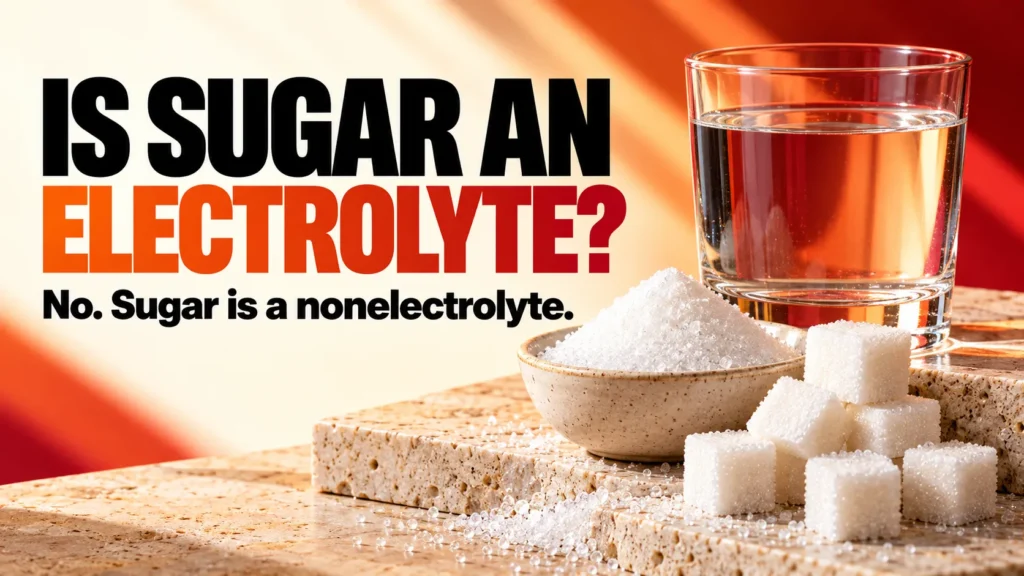
No, sugar is not an electrolyte. Table sugar, glucose, and fructose dissolve in water as electrically neutral molecules rather than separating into charged ions. Sugar can supply energy, and glucose can help your intestine absorb sodium and water in an appropriately formulated drink. Those roles explain its presence in some hydration products, but they do not make sugar an electrolyte.
Table of Contents
The useful question is what each ingredient contributes: sugar provides carbohydrate, electrolyte salts provide ions, and water provides fluid. A drink can contain all three, or contain electrolytes without added sugar.
Why Is Sugar a Nonelectrolyte?
An electrolyte produces mobile ions when dissolved in water. Table sugar, also called sucrose, stays in molecular form. Dissolving makes it disappear from view, but does not turn it into sodium, potassium, or another charged mineral.
That distinction separates solubility from electrical conductivity. Something can dissolve readily and still be a nonelectrolyte. Sugar is therefore not a weak electrolyte; it belongs to a different category. OpenStax’s chemistry explanation distinguishes substances that generate ions from those that do not.
Sugar and salt behave differently
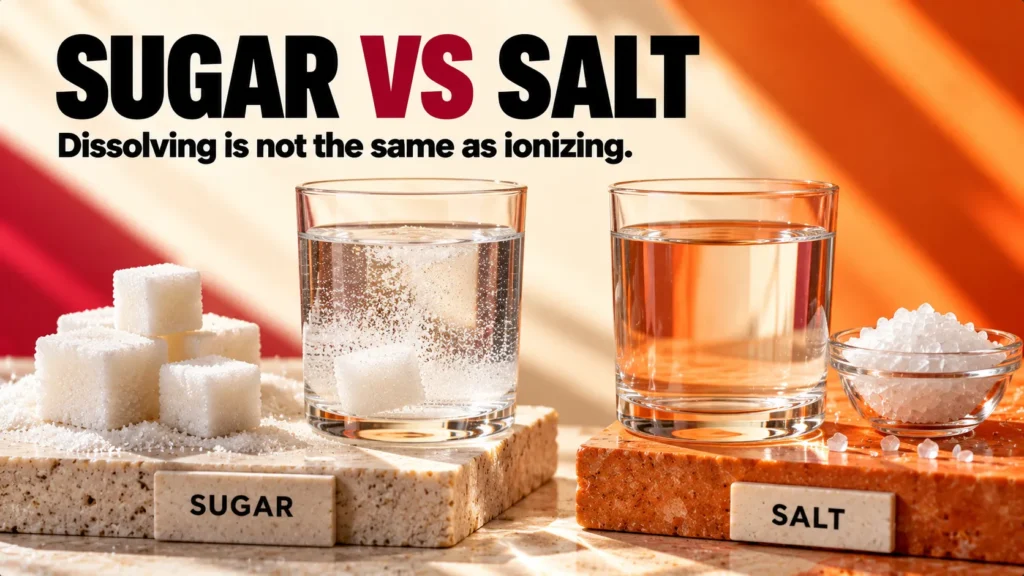
Table salt separates into positively charged sodium ions and negatively charged chloride ions in water. Sugar molecules remain neutral. That is why adding salt supplies electrolytes while adding purified sugar does not.
| Ingredient | Behavior in water | Electrolyte source? |
| Table sugar or sucrose | Dissolves as neutral molecules | No |
| Glucose or dextrose | Dissolves as neutral molecules | No |
| Sodium chloride or table salt | Separates into sodium and chloride ions | Yes |
| Potassium chloride | Separates into potassium and chloride ions | Yes |
The table describes the ingredients themselves. A finished sweet drink may contain electrolytes from other ingredients.
What Electrolytes Do in Your Body
Sodium, potassium, chloride, magnesium, and calcium are examples of electrolytes involved in normal body functions. They help regulate fluid balance and support nerves and muscles. Your body needs appropriate amounts, rather than simply the largest number printed on a packet. MedlinePlus explains that electrolyte levels can become too high or too low.
Food and beverages both contribute to intake. A sweet flavor does not tell you which minerals a drink contains, and an unsweetened flavor does not mean minerals are absent. Look at the listed sodium and potassium amounts instead of judging by taste.
For a practical example of how mineral amounts can differ between drink mixes, our Instant Hydration vs Re-Lyte comparison walks through the label differences. The useful comparison is the complete formula and intended serving, rather than sweetness alone.
Why Do Electrolyte Drinks Contain Sugar?
There are several possible reasons: carbohydrate fuel during exercise, support for a particular intestinal absorption pathway, and a taste people enjoy drinking. These purposes overlap, but they are not interchangeable evidence of better hydration.
Glucose can help sodium and water absorption
In the small intestine, a transport protein called SGLT1 moves glucose and sodium into intestinal cells together. Water follows the resulting osmotic gradient. This mechanism helps explain why carefully formulated oral rehydration solutions combine glucose with salts.
Glucose is participating in transport; sodium is the electrolyte. The mechanism does not establish that every sugary beverage hydrates faster, or that adding extra sugar improves a commercial mix. Concentration matters, and a finished product needs evidence for any specific performance claim.
Carbohydrate can also provide exercise fuel
During prolonged exercise, a carbohydrate-containing sports drink can serve two purposes: supplying fluid and helping meet fueling needs. ACSM notes that sports drinks may benefit endurance activity lasting more than an hour, especially with substantial sweating.
That does not make every workout a reason to drink sugar. A short, easy session and a long training day create different demands. Decide whether you need carbohydrate during the activity before choosing a drink because it promises energy.
When comparing formulas with different sugar approaches, our Liquid I.V. vs Waterboy guide provides another way to examine the ingredients. Check the exact product line: a brand name can cover several formulas.
Do Electrolytes Need Sugar to Work?
No. Glucose-assisted sodium transport is one absorption pathway, rather than the only way your body absorbs sodium or water. Sugar-free drinks can contain dissolved electrolyte salts without glucose. The absence of sugar does not erase the sodium or potassium listed on the label.
For ordinary daily activity and shorter exercise, water is often a suitable starting point. ACSM’s guidance favors water for short-duration exercise and distinguishes it from the demands of endurance activity. You do not have to sweeten water to make drinking it useful.
A sugar-free formula also does not provide carbohydrate fuel simply because it contains electrolytes. Someone using it on a long outing may need a separate fueling plan. Conversely, someone seeking fluid during a routine day may have no reason to add exercise carbohydrates.
Is Sugar Water the Same as Oral Rehydration Solution?
No. Sugar water lacks the deliberately balanced salts found in oral rehydration solution, or ORS. Medical rehydration formulas are designed for a specific purpose; an arbitrary mixture of sugar and water is not equivalent.
CDC guidance explains that appropriately balanced glucose and sodium support oral rehydration, while very sugary liquids can worsen diarrhea. Use a commercial ORS as directed when it is appropriate, rather than adding sugar to an ordinary electrolyte product or improvising a recipe.
Sports drinks and general hydration powders should not automatically be substituted for ORS during illness. Seek medical help for severe dehydration, confusion, or inability to keep fluids down; children with illness-related dehydration need particular care. This article explains ingredients and does not provide individualized treatment advice.
How to Read an Electrolyte Drink Label

A useful label review starts with the amount you will actually prepare and drink. One packet, one scoop, and one bottle are not automatically comparable servings.
Check minerals separately from sugar
Read sodium and potassium in milligrams, then check total carbohydrate, total sugars, and added sugars in grams. These lines describe different parts of the formula. More sugar does not demonstrate more electrolyte content, and more minerals do not automatically make a drink more suitable.
FDA distinguishes total sugars from added sugars on the Nutrition Facts label. If you drink two servings, account for twice the listed nutrients. An ingredient such as dextrose is glucose; it contributes sugar even though the ingredient list does not use the familiar word “sugar.”
Follow the mixing directions
Use the stated water volume. Changing it changes the concentration of everything dissolved in the drink. A concentrated scoop mixed into a small glass is a different beverage from the same scoop mixed into a large bottle.
Our Ultima vs LMNT comparison is a useful reminder to compare mineral profiles even when shopping among sugar-free options. Use current package directions and choose around your needs, rather than assuming every zero-sugar mix serves the same purpose.
Frequently Asked Questions
Is glucose an electrolyte?
No. Glucose, also called dextrose, is a sugar. Its role in sodium-glucose transport does not change its classification as a nonelectrolyte.
Does adding sugar to water add electrolytes?
Purified sugar adds carbohydrate, not electrolyte salts. Minerals already in the water or added through other ingredients are a separate matter.
Does a sweet drink necessarily contain electrolytes?
No. Sweetness alone cannot establish a mineral profile. Check the sodium and potassium amounts and the ingredient list rather than assuming a sweet drink is an electrolyte replacement.
Should I add sugar to a sugar-free electrolyte powder?
Follow the product’s directions. Adding sugar changes its carbohydrate content and concentration without proving better hydration. For endurance exercise, plan carbohydrate needs separately; for illness-related fluid loss, use appropriate medical guidance.
What This Means When Choosing a Drink
Is sugar an electrolyte? No. It can have a useful role in a drink, but that role is separate from the minerals. Choose around the situation: fluid for ordinary thirst, a considered combination of fluid and fuel for prolonged exercise, and an appropriate rehydration solution when illness calls for it. Read the full formula before treating sugar as either a requirement or a drawback.
This article contains affiliate links. If you purchase through our links, we may earn a commission at no extra cost to you. We only recommend products we genuinely believe in. Read our Affiliate Disclaimer for full details.