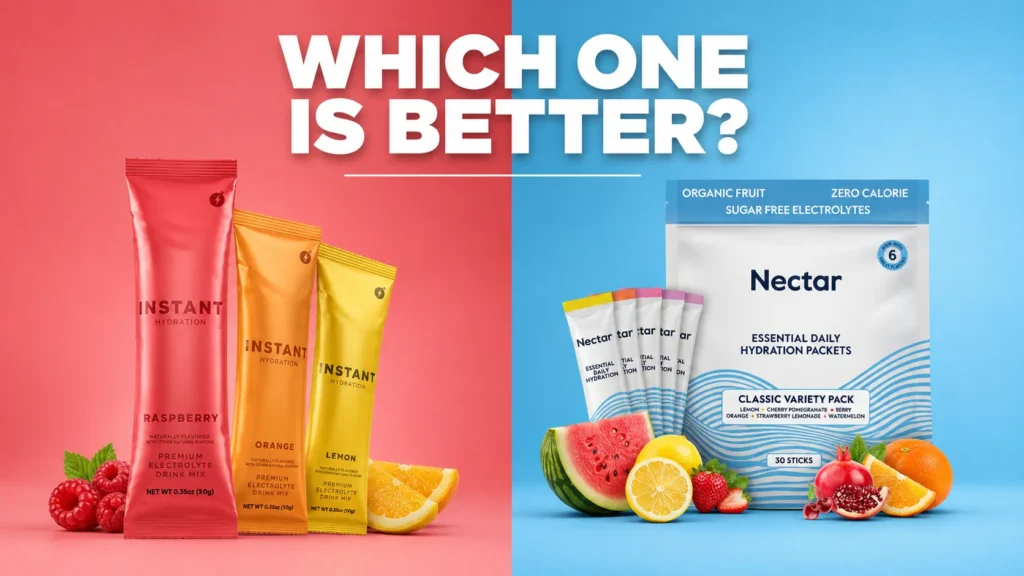
Instant Hydration vs Nectar comes down to electrolyte concentration and intended use. Instant Hydration provides substantially more sodium, potassium, magnesium, and calcium per stick, while Nectar Essential Daily Hydration offers a lighter, zero-calorie formula with less sodium. Both are sugar-free and sweetened with stevia, so the better choice depends on how much electrolyte replacement you actually want.
Table of Contents
That difference matters more than either brand’s lifestyle marketing. Instant Hydration supplies 1,240 mg of its four listed electrolytes per serving and is built like a stronger workout or hot-weather formula. Nectar provides a lighter mineral dose that is easier to fit into an ordinary day when you are not losing large amounts of sodium through sweat.
This Instant Hydration vs Nectar comparison evaluates the exact flagship formulas: Instant Hydration Electrolyte Powder and Nectar Essential Daily Hydration. It uses current labels and prices rather than assuming every product sold by either company has the same formula.
Instant Hydration vs Nectar: Quick Verdict
Choose Instant Hydration if your priority is more sodium, potassium, magnesium, and calcium per packet. It is the stronger option for long, sweaty workouts and situations where meaningful mineral replacement is the goal.
Choose Nectar Essential Daily Hydration if you want a mild, low-sodium, zero-calorie mix for routine use, travel, desk days, or light exercise. It also costs less at the current one-bag price.
There is no universal winner. The best product depends on whether you need a substantial electrolyte dose or simply want lightly flavored water with a modest mineral contribution.
Nutrition Facts at a Glance
| Per labeled serving | Instant Hydration | Nectar Essential Daily Hydration |
|---|---|---|
| Serving format | 1 stick | 1 stick |
| Suggested water | 16–24 fl oz | 8–16 fl oz |
| Calories | 10 | 0 |
| Sugar | 0 g | 0 g |
| Sodium | 500 mg | 100 mg |
| Potassium | 470 mg | 250 mg |
| Magnesium | 100 mg | 50 mg |
| Calcium | 170 mg | 75 mg |
| Chloride | Not separately stated on current page | 150 mg |
| Sweeteners | Stevia and monk fruit | Stevia |
| Standard displayed price* | $49.50 for 30 | $37.95 for 30 |
| Approximate price per stick* | $1.65 | $1.27 |
*Prices and promotions checked September 3, 2026. Subscription and bundle offers can change. Nectar’s mineral quantities were verified against its current published label data; shoppers should recheck the physical package because the official product page currently hides the numeric panel inside an image.
The Differences That Matter Most
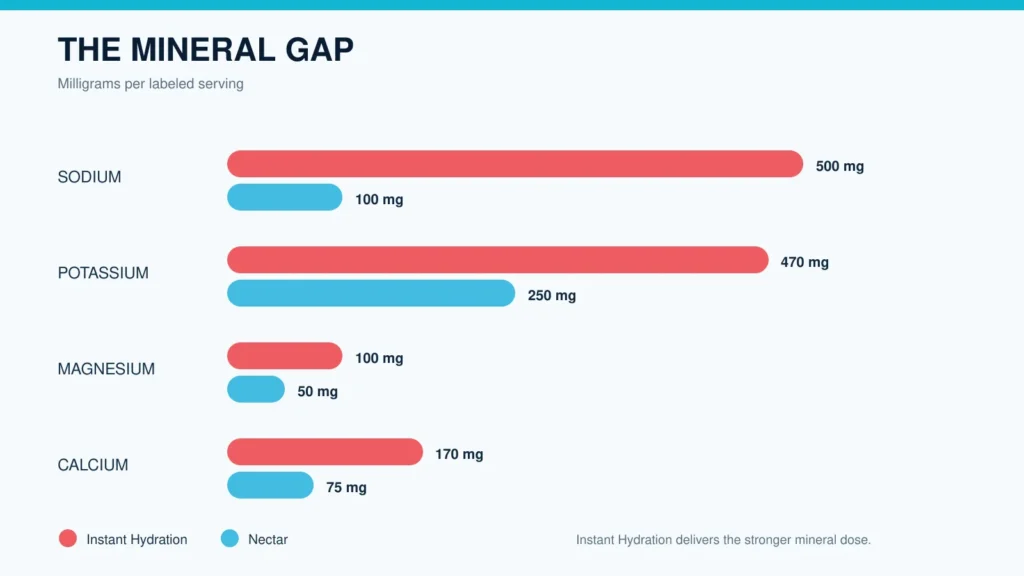
The comparison comes down to five practical differences:
- Instant Hydration provides five times as much sodium.
- Instant Hydration supplies nearly twice as much potassium and twice as much magnesium.
- Nectar is calorie-free, while Instant Hydration has 10 calories.
- Nectar costs less at the current one-bag price.
- Nectar is positioned for everyday sipping; Instant Hydration makes more sense when electrolyte replacement needs are higher.
These are not small formulation variations. They create two products for different jobs.
Sodium: 500 mg vs 100 mg
Sodium is the largest difference in the entire Instant Hydration vs Nectar comparison.
Instant Hydration contains 500 mg sodium per stick. Nectar provides 100 mg. Instant therefore supplies five times as much sodium per serving.
That gives Instant Hydration the advantage after prolonged exercise, substantial sweating, or time in hot conditions. Sodium is an important electrolyte lost in sweat, but requirements vary widely with exercise duration, climate, sweat rate, diet, and the individual.
The American College of Sports Medicine’s fluid-replacement guidance emphasizes personalized hydration programs because both sweat rate and sweat electrolyte concentration vary. It also notes that electrolyte-containing drinks can offer benefits over water in certain exercise circumstances.
Nectar’s 100 mg is the more conservative amount for an ordinary workday or light activity. It adds flavor and some electrolytes without using a large share of the FDA’s sodium Daily Value. That does not make it automatically healthier; it simply makes it a different tool.
For another example of how dramatically sodium levels can change a product’s purpose, ElectrolyteDaily’s Ultima vs LMNT comparison contrasts a low-sodium daily formula with a 1,000 mg high-sodium mix.
Sodium winner: Instant Hydration for heavy sweating; Nectar for routine low-sodium use.
Potassium, Magnesium, and Calcium
Instant Hydration also leads on the other listed minerals:
- Potassium: 470 mg vs Nectar’s 250 mg
- Magnesium: 100 mg vs 50 mg
- Calcium: 170 mg vs 75 mg
The advantage is quantity, not proof that every mineral form is superior.
Instant Hydration uses potassium chloride, magnesium bisglycinate chelate, and calcium derived from mineralized algae. Nectar lists potassium citrate, magnesium citrate, and calcium citrate. Both formulas use recognizable mineral compounds, but absorption and tolerance depend on the compound, dose, diet, and individual.
Instant Hydration is the logical choice if you specifically want an electrolyte drink to contribute more magnesium and calcium. Nectar is deliberately lighter and should not be described as equivalent mineral replacement at a lower price.
People with kidney disease, medically elevated potassium, or clinician-directed mineral restrictions should not select either formula from a comparison table alone. Instant Hydration contains 470 mg potassium and Nectar contains 250 mg, and repeated servings increase those totals quickly.
Mineral-density winner: Instant Hydration.
Sugar, Calories, and Sweeteners
Both products avoid added sugar.
Instant Hydration lists zero sugar and 10 calories. It uses organic stevia leaf extract and organic monk fruit extract. Nectar lists zero sugar and zero calories and uses organic stevia leaf extract.
Neither is suitable for someone who dislikes stevia. Instant Hydration’s addition of monk fruit may create a different sweetness profile, but taste cannot be predicted from the ingredient list alone.
The 10-calorie difference is nutritionally minor for most adults. Nectar still earns the technical win for people who want a truly zero-calorie drink.
Sugar and calorie winner: Nectar, narrowly.
Ingredients Compared
Instant Hydration ingredients
The Raspberry formula lists an Instant Hydration blend containing sel gris/French grey sea salt, magnesium bisglycinate chelate, potassium chloride, and calcium from mineralized algae. The remaining ingredients include citric acid, malic acid, natural flavors, organic stevia leaf extract, and organic monk fruit extract.
Other flavors may add plant-derived colors or use slightly different acid and flavor combinations. The official Instant Hydration product page should be checked for the exact flavor you intend to buy.
Nectar ingredients
Nectar Essential Daily Hydration lists organic fruit flavor, pink Himalayan salt, potassium citrate, magnesium citrate, calcium citrate, non-GMO citric and malic acids, and organic stevia leaf extract.
Its official Essential Daily Hydration page describes the formula as sugar-free, zero-calorie, and low-sodium. Nectar also sells Energy and Calm products; their added functional ingredients make them separate formulas and they should not be substituted into this comparison.
Both brands use “natural” or organic-positioned language, but shoppers should focus on the actual ingredient list and label. Terms such as “cellular hydration,” “premium,” and “medical grade” are not substitutes for comparative clinical trials.
Ingredient winner: Tie. Instant Hydration offers a broader sweetener and mineral system; Nectar has the shorter, lighter formula.
Which Is Better for Workouts?
Instant Hydration is usually the more logical workout option because its 500 mg sodium is meaningful compared with Nectar’s 100 mg. It also supplies more potassium, magnesium, and calcium.
That does not mean every gym session requires it. For exercise lasting less than about an hour, especially in mild conditions, plain water and normal meals may be sufficient for many healthy adults. Older but widely cited ACSM guidance found little evidence of performance differences between water and carbohydrate-electrolyte drinks during exercise lasting less than one hour.
For longer sessions, heat, or a known high sweat rate, Instant Hydration’s stronger sodium dose is more relevant. Neither product contains meaningful carbohydrate fuel, so endurance athletes who need carbohydrates must obtain them elsewhere.
Workout winner: Instant Hydration.
Which Is Better for Everyday Hydration?
Nectar is the better everyday default for most people who are not sweating heavily.
Its 100 mg sodium, zero calories, and lighter 8–16 ounce preparation make it easy to use as a flavored-water alternative. The current formula still provides potassium, magnesium, calcium, and chloride, but at lower amounts than Instant Hydration.
Instant Hydration can also be used on ordinary days, but its 500 mg sodium and 470 mg potassium should be counted as part of the full diet. Multiple sticks can quickly turn an apparently simple hydration habit into a substantial mineral intake.
The National Academies notes that most healthy people can generally meet hydration needs by following thirst and normal beverage habits, while heat and physical activity raise fluid needs. An electrolyte packet is a convenience, not a requirement for every glass of water.
Everyday winner: Nectar.
Flavor Selection and Taste Expectations
Instant Hydration currently advertises 14 hydration flavors, including Raspberry, Watermelon, Cherry Limeade, Paloma, Orange, Mango Pineapple, Lemon Lime, Cotton Candy, P.O.G., Lychee, Strawberry Lemon, Peach Pineapple, and licensed seasonal options. Its 500 mg sodium may create a more noticeable mineral taste, though the finished intensity depends on how much water you use.
Nectar currently presents six light fruit flavors: Variety Pack, Fresh Lemon, Wild Berry, Sunrise Orange, Cherry Pomegranate, Strawberry Lemonade, and Watermelon are shown across its current selection interface, with the variety assortment covering six flavors. The company recommends 8–16 ounces of water and positions the taste as light rather than sports-drink-like.
Because this is a research comparison rather than a hands-on taste test, it would be misleading to declare one “better tasting.” People sensitive to stevia may notice an aftertaste in either product.
Flavor-range winner: Instant Hydration.
Lighter-taste positioning: Nectar.
Price and Subscription Value
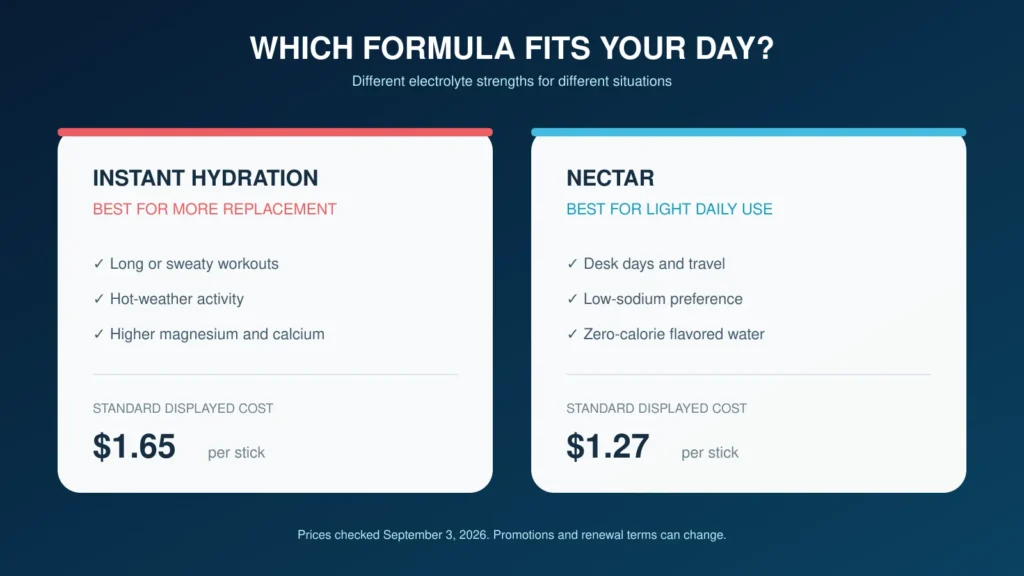
At the prices displayed during research of Instant Hydration vs Nectar:
- Instant Hydration one-time: $49.50 for 30 sticks, or $1.65 each
- Nectar one bag: $37.95 for 30 sticks, or about $1.27 each
- Difference: Nectar costs about $11.55 less per 30-serving bag
Instant Hydration displayed a first-order subscription promotion of $27.50, or roughly $0.92 per stick. Nectar displayed lower per-bag pricing as bundle quantity increased, reaching $24.95 per bag for four bags on the page checked.
Promotional prices are not the same as standard long-term cost. Before subscribing, check the renewal price, delivery frequency, cancellation terms, shipping, and whether the discount applies only to the first shipment.
Standard one-bag value winner: Nectar.
Promotional winner: Variable; verify the live checkout terms.
Instant Hydration vs Nectar for Specific Needs
| Need | Better choice | Why |
|---|---|---|
| Long or sweaty workouts | Instant Hydration | Five times Nectar’s sodium and more total listed minerals |
| Hot-weather activity | Instant Hydration | Stronger sodium replacement profile |
| Desk-day hydration | Nectar | Lighter sodium dose and zero calories |
| Low-sodium preference | Nectar | 100 mg vs 500 mg sodium |
| Higher magnesium | Instant Hydration | 100 mg vs 50 mg |
| Higher calcium | Instant Hydration | 170 mg vs 75 mg |
| Lowest standard one-bag price | Nectar | About $1.27 vs $1.65 per serving |
| Avoiding stevia | Neither | Both formulas contain stevia |
| Carbohydrate fueling | Neither | Both are sugar-free and not designed as carbohydrate fuel |
Potential Drawbacks
Instant Hydration drawbacks
- Costs more at the standard one-time price
- 500 mg sodium may be unnecessary for casual use
- 470 mg potassium may not fit a medically restricted plan
- Contains stevia, monk fruit, and natural flavors
- Strong promotional pricing can obscure the renewal cost
Nectar drawbacks
- Only 100 mg sodium may be insufficient for long, sweaty training
- Provides about half as much magnesium and less than half as much calcium
- Contains stevia and natural flavor
- Some benefit statements on the brand’s page go beyond what the product label alone can prove
- Current numeric nutrition facts are presented mainly through an image, making quick label verification less convenient
Final Verdict
The winner depends on the job in Instant Hydration vs Nectar.
Instant Hydration wins for exercise and mineral density. Its 500 mg sodium, 470 mg potassium, 100 mg magnesium, and 170 mg calcium create a materially stronger electrolyte formula. It is the better match for prolonged sweating, hot conditions, or buyers who specifically want more minerals per packet.
Nectar wins for everyday hydration and standard-price value. Its 100 mg sodium, zero calories, light flavor positioning, and approximately $1.27 one-bag serving cost make it easier to use during normal days when heavy electrolyte replacement is unnecessary.
If you are still unsure, start by identifying your actual use case. A low-sodium daily drink and a higher-electrolyte workout mix are not interchangeable, even when both are sugar-free powders sold in 30-stick bags.
Frequently Asked Questions
Is Instant Hydration better than Nectar?
Instant Hydration is better for substantial electrolyte replacement and workouts. Nectar is better for low-sodium everyday hydration and costs less at the standard one-bag price. Neither is universally better.
Which has more sodium, Instant Hydration or Nectar?
Instant Hydration has 500 mg sodium per stick, while Nectar Essential Daily Hydration has 100 mg. Instant provides five times as much sodium.
Which has more magnesium?
Instant Hydration supplies 100 mg magnesium per serving. Nectar supplies 50 mg.
Are Instant Hydration and Nectar sugar-free?
Yes. Both flagship formulas list zero sugar. Nectar lists zero calories; Instant Hydration lists 10 calories.
Do both products contain stevia?
Yes. Nectar uses organic stevia leaf extract. Instant Hydration uses organic stevia leaf extract plus organic monk fruit extract.
Is Nectar good for heavy sweating?
Its 100 mg sodium may be too light for prolonged, high-sweat exercise. Hydration needs vary, but Instant Hydration’s 500 mg sodium is more aligned with substantial sweat replacement.
Can I drink either product every day?
Healthy adults may use electrolyte powders as part of their fluid intake, but daily need depends on diet, activity, climate, medications, and health conditions. People managing kidney, heart, blood-pressure, or electrolyte disorders should ask a qualified clinician about the exact formula and serving frequency.
Medical disclaimer: This article provides general product and nutrition information, not medical advice. It does not diagnose, prevent, or treat dehydration or any health condition.
This article contains affiliate links. If you purchase through our links, we may earn a commission at no extra cost to you. We only recommend products we genuinely believe in. Read our Affiliate Disclaimer for full details.