
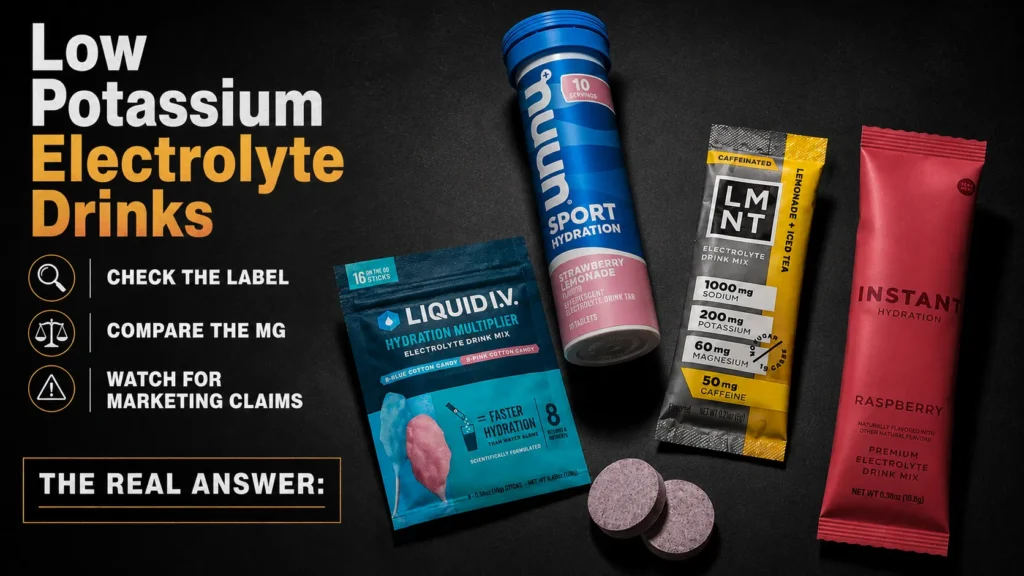
The lowest-potassium electrolyte drinks in this comparison are Nuun Sport, with 150 mg per tablet, and LMNT, with 200 mg per stick. Liquid I.V. Hydration Multiplier and Instant Hydration contain more. People with kidney, heart, or medication-related potassium restrictions should not rely on a general product ranking and should ask a qualified healthcare professional for an individualized limit.
Table of Contents
“Low potassium” sounds straightforward until you look at electrolyte labels. Some products provide less than 50 mg per serving. Others contain several hundred milligrams but still market themselves for everyday hydration. Serving sizes, sodium levels, sugar, and preparation volume vary, so potassium cannot be judged in isolation.
This guide compares four current formulas-including the three brands requested most often-to identify which genuinely provide less potassium per serving and what tradeoffs come with that choice.
Quick Ranking: Lowest Potassium First
| Rank | Exact product | Potassium | Potassium DV | Sodium | Sugar | Price per serving* | Verdict |
|---|---|---|---|---|---|---|---|
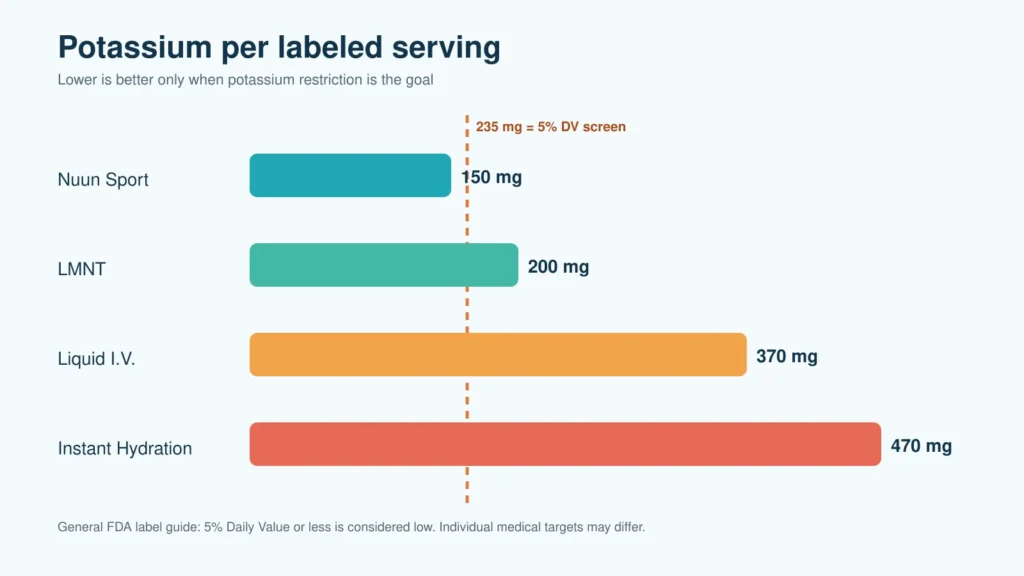
| 1 | Nuun Sport tablet | 150 mg | About 3% | 300 mg | 1 g | $0.75 | Lowest potassium and sodium in this group |
| 2 | LMNT Drink Mix | 200 mg | About 4% | 1,000 mg | 0 g | $1.50 | Low potassium, but very high sodium |
| 3 | Liquid I.V. Lemon Lime Hydration Multiplier | 370 mg | 8% | 500 mg | 11 g added sugar | $1.56 | Not low under the general 5% DV guide |
| 4 | Instant Hydration Electrolyte Powder | 470 mg | 10% | 500 mg | 0 g | $1.65 promotional one-time price | Highest potassium in this comparison |
Official one-time prices checked September 2, 2026. Promotions and availability can change.
How We Chose
The ranking starts with potassium per labeled serving, not marketing language or total electrolyte count. We then considered:
- Potassium amount and percent Daily Value
- Sodium, because many people monitoring potassium also need to consider sodium
- Sugar and calories
- Sweeteners and ingredients
- Serving format and water volume
- Current official price and cost per serving
- Whether the product offers a realistic use case beyond simply having the smallest number
The FDA’s Daily Value guide sets the potassium Daily Value at 4,700 mg and explains that 5% DV or less is generally considered low. That makes 235 mg potassium a useful screening line for this article.
However, it is only a general label-reading benchmark. It does not determine what someone with chronic kidney disease, high blood potassium, or a medication-related restriction should consume.
1. Nuun Sport – Lowest Potassium and Best Budget Pick
Best for: Shoppers who want a lower-potassium, moderate-sodium sports tablet at a comparatively low price
One Nuun Sport tablet mixed with 16 fluid ounces of water provides:
- Potassium: 150 mg, or 4% DV on the current label
- Sodium: 300 mg
- Magnesium: 25 mg
- Calcium: 13 mg
- Sugar: 1 g, including 1 g added sugar
- Calories: 15
Nuun Sport ranks first because its 150 mg potassium is the lowest verified amount among these four products. The company currently lists a 10-tablet tube at $7.49, or about $0.75 per serving, making it the least expensive option here as well.
The formula uses sodium bicarbonate and sodium carbonate alongside potassium bicarbonate and potassium chloride. It also contains magnesium oxide, calcium carbonate, dextrose, stevia, acids, natural flavor, and color ingredients that vary by flavor. The official Nuun Sport page lists the current label, preparation instructions, flavors, and price.
Its 300 mg sodium is considerably lower than LMNT’s 1,000 mg. That may make Nuun easier to fit into a general daily diet, although it is not automatically suitable for anyone with a medical sodium limit.
Nuun Sport advantages
- Lowest potassium in the comparison
- Lowest sodium among the four
- Lowest cost per serving
- Compact tablet tube
- Only 1 g sugar
- Multiple caffeine-free flavors available
Nuun Sport drawbacks
- Contains potassium chloride and potassium bicarbonate, so it is not potassium-free
- Provides less sodium than some heavy sweaters may want during long or hot training
- Contains stevia and 1 g added sugar
- Tablet takes a few minutes to dissolve
2. LMNT Drink Mix – Low Potassium but Extremely Sodium-Forward
Best for: Heavy sweaters who specifically need substantial sodium while keeping potassium below 5% DV
LMNT Drink Mix provides:
- Potassium: 200 mg, about 4% DV
- Sodium: 1,000 mg, about 43% DV
- Magnesium: 60 mg
- Sugar: 0 g
- Calories: 5–10 depending on flavor
At 200 mg potassium, LMNT fits under the FDA’s general 5% DV guide. It is not a gentle everyday formula, however. One stick also provides 1,000 mg sodium-more than three times the sodium in Nuun Sport.
That tradeoff defines LMNT. It can make sense for prolonged exercise, hot conditions, and people who lose substantial sodium through sweat. It may be a poor match for someone who chose a low-potassium product because they also need to control sodium.
The flavored versions contain salt, potassium chloride, magnesium malate, flavor-specific citric or malic acid, natural flavors, and stevia. Raw Unflavored contains only salt, magnesium malate, and potassium chloride. You can examine the flavor-specific formulas on LMNT’s official ingredients page.
LMNT currently charges $45 for 30 sticks, or $1.50 each. The displayed subscription price is $39, or $1.30 per stick. Its Insider bundle can reduce the per-serving cost further.
For a broader comparison of LMNT’s high-sodium approach, ElectrolyteDaily’s Ultima vs LMNT comparison shows how dramatically electrolyte formulas can differ even when both contain zero sugar. That older comparison should be refreshed against current labels before publication updates are made.
LMNT advantages
- 200 mg potassium stays below 5% DV
- Zero sugar
- Raw Unflavored contains no sweetener or natural flavor
- Substantial sodium for high-sweat use cases
- Transparent flavor-specific ingredient lists
LMNT drawbacks
- 1,000 mg sodium is high for casual use
- Not an appropriate default for people limiting sodium
- Costs twice as much per serving as Nuun Sport at standard one-time prices
- Strong saltiness may require more water
3. Liquid I.V. Hydration Multiplier – Moderate Potassium, Not Truly Low
Best for: Buyers who prioritize carbohydrate-containing hydration and vitamins over minimizing potassium
Liquid I.V. Lemon Lime Hydration Multiplier lists:
- Potassium: 370 mg, or 8% DV
- Sodium: 500 mg, or 22% DV
- Sugar: 11 g, all added sugar
- Carbohydrate: 11 g
- Calories: 45
- Vitamin C and several B vitamins
With 370 mg potassium, Liquid I.V. contains 170 mg more than LMNT and 220 mg more than Nuun Sport. That does not make it a high-potassium food under the FDA’s general framework, but it also does not fit the 5%-or-less low guide.
The standard Hydration Multiplier uses sugar and dextrose rather than being sugar-free. Carbohydrate can be useful during some longer exercise sessions, but an 11 g added-sugar serving may be unnecessary for routine desk-day hydration. The exact label and current 16-stick price are available on the official Liquid I.V. Lemon Lime page.
One pouch costs $24.99, or $1.56 per stick. The official site currently displays a 30%-off subscription price of $17.49, or $1.09 per stick.
Liquid I.V. sells several product lines, including sugar-free, energy, immune-support, and kids formulas. Do not assume every line has the same potassium, sodium, sugar, or calorie content. This ranking applies only to the standard Lemon Lime Hydration Multiplier label checked for this article.
Liquid I.V. advantages
- Moderate 500 mg sodium
- Carbohydrate may support fueling during appropriate exercise situations
- Includes vitamin C and B vitamins
- Broad flavor availability
- Subscription price is competitive
Liquid I.V. drawbacks
- 370 mg potassium is above the general low-%DV guide
- Contains 11 g added sugar
- Product-line labels vary, creating easy comparison errors
- Not the best choice when minimizing potassium is the main goal
4. Instant Hydration – Broad Mineral Formula, Highest Potassium Here
Best for: Buyers who want potassium, magnesium, and calcium-not people chiefly trying to minimize potassium
Instant Hydration lists:
- Potassium: 470 mg, or 10% DV
- Sodium: 500 mg, or 22% DV
- Magnesium: 100 mg
- Calcium: 170 mg
- Sugar: 0 g
- Calories: 10
Instant Hydration ranks last for this specific search intent because 470 mg is the highest potassium amount in the comparison. Its formula may appeal to someone seeking a broader mineral profile, but that strength works against it in a low-potassium buying guide.
The current ingredients include sel gris/French grey sea salt, magnesium bisglycinate chelate, potassium chloride, calcium from mineralized algae, acids, natural flavors, organic stevia, and organic monk fruit. The official Instant Hydration product page lists current nutrition details, ingredients, flavors, and pricing.
When checked, the site showed a $55 regular price and a $49.50 promotional one-time price for 30 servings, or $1.65 per stick. It also displayed a much lower subscription promotion, but shoppers should verify the renewal price before ordering.
Instant Hydration advantages
- Zero sugar
- More magnesium and calcium than the other products in this comparison
- Broad advertised flavor range
- Moderate sodium relative to LMNT
Instant Hydration drawbacks
- Highest potassium in the comparison
- Does not fit the general 5% DV low guide
- Contains potassium chloride
- Subscription renewal pricing is not sufficiently clear to treat the introductory offer as permanent
Potassium and Sodium Must Be Considered Together
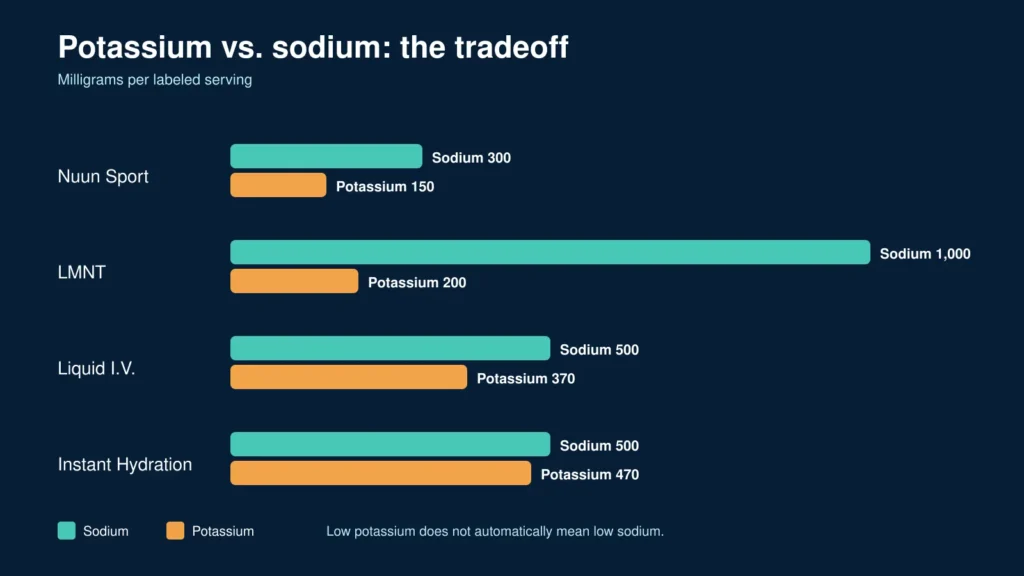
A low-potassium number can distract from a high sodium number. LMNT demonstrates this perfectly: its 200 mg potassium qualifies as low under the general %DV screen, but its 1,000 mg sodium is high.
The FDA’s sodium guidance sets the Daily Value at less than 2,300 mg and classifies 20% DV or more per serving as high. By that measure:
- Nuun Sport: 300 mg sodium, about 13% DV
- Liquid I.V.: 500 mg, about 22% DV
- Instant Hydration: 500 mg, about 22% DV
- LMNT: 1,000 mg, about 43% DV
Someone comparing products for exercise may reasonably prioritize sweat replacement. Someone managing kidney function, blood pressure, swelling, or heart disease may have a completely different target. The front of the package cannot make that decision.
Are Low Potassium Electrolyte Drinks Safe for Kidney Disease?
No universal product recommendation is appropriate for kidney disease.
The National Institute of Diabetes and Digestive and Kidney Diseases explains that chronic kidney disease can make it harder to remove potassium from the blood. It also notes that potassium needs vary and that some people with CKD must monitor sodium, phosphorus, protein, and total fluid-not potassium alone.
All four products in this guide contain potassium compounds. LMNT and Nuun may look lower on the label, but LMNT’s sodium load may conflict with a clinician-directed plan. Nuun’s 150 mg may still matter if several servings or other supplements are consumed.
If your reason for seeking electrolyte drinks low in potassium is high blood potassium, dialysis, reduced kidney function, heart failure, or medication use, ask your renal dietitian or clinician about:
- Your potassium allowance per serving and per day
- Your sodium limit
- Fluid restrictions
- Whether magnesium and phosphorus need monitoring
- How many servings are appropriate
- Potential interactions with medications
Do not use this ranking to self-treat an electrolyte disorder or replace a prescribed oral rehydration solution.
How to Read the Label
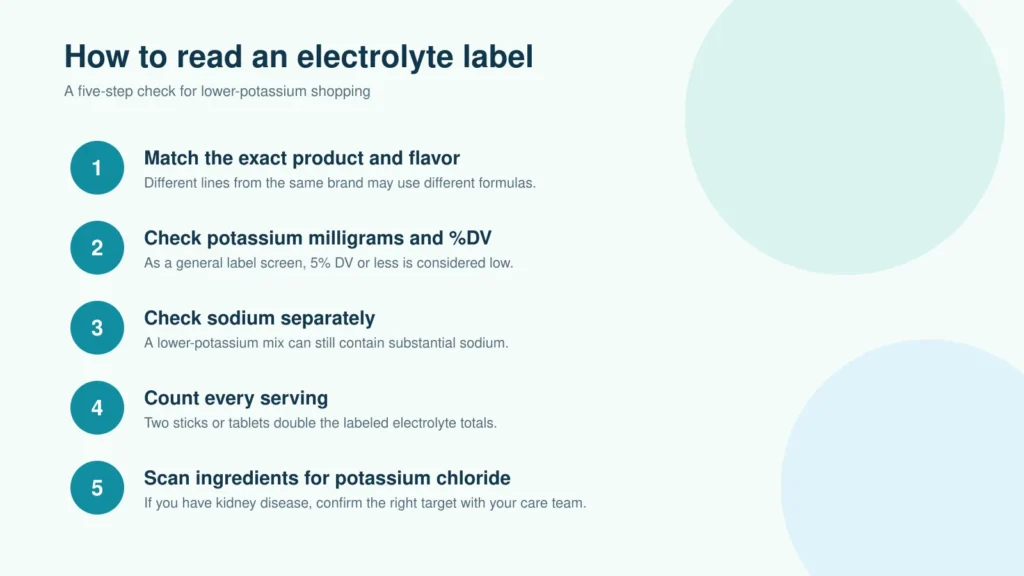
Use this five-step check before buying:
- Identify the exact formula. “Liquid I.V.” is a brand, not one nutrition label. The same is true for other companies with multiple product lines.
- Read potassium per serving. Under the FDA’s general guide, 235 mg or less equals 5% DV or less.
- Check sodium next. Low potassium does not imply low sodium.
- Count the servings you will actually drink. Two LMNT sticks provide 400 mg potassium but also 2,000 mg sodium.
- Look for potassium chloride. NIDDK specifically advises people with high potassium to limit packaged foods containing potassium chloride when directed by their healthcare team.
Mixing a packet into more water reduces the concentration per ounce, but it does not reduce the total potassium consumed if you drink the entire bottle.
Which Product Should You Choose?
Choose Nuun Sport if your priority is the lowest potassium, lowest sodium, and lowest price among these four products.
Choose LMNT if you need a low-potassium-by-%DV product specifically for substantial sodium replacement and its 1,000 mg sodium fits your plan.
Choose Liquid I.V. Hydration Multiplier if potassium minimization is not strict and you want a carbohydrate-containing formula with vitamins.
Choose Instant Hydration if you want more potassium, magnesium, and calcium. It is a poor match when “low potassium” is the main requirement.
Frequently Asked Questions
What electrolyte drink has the least potassium?
Among the four products compared here, Nuun Sport has the least potassium at 150 mg per tablet. LMNT is next at 200 mg per stick. Product labels can change, so verify the package before purchase.
Is LMNT low in potassium?
LMNT contains 200 mg potassium, or about 4% of the FDA Daily Value. That fits the FDA’s general label-reading guide of 5% DV or less as low. However, LMNT also supplies 1,000 mg sodium, so it may not suit people who must limit both minerals.
Is Liquid I.V. low in potassium?
Standard Lemon Lime Liquid I.V. Hydration Multiplier contains 370 mg potassium, or 8% DV. That is not high under the general FDA guide, but it is above the 5%-or-less low benchmark.
Is Instant Hydration low in potassium?
No. Instant Hydration contains 470 mg potassium, or 10% DV, per stick. It has the most potassium among the four products evaluated in this guide.
Does adding more water lower the potassium?
It lowers the potassium concentration per ounce but not the total dose. A packet containing 200 mg potassium still supplies 200 mg whether mixed into 16 or 32 ounces, assuming you drink it all.
Are electrolyte drinks potassium-free?
Some may be, but none of the four products evaluated here is potassium-free. Check both the Nutrition Facts and ingredient list because potassium compounds can appear as potassium chloride or potassium bicarbonate.
Can I drink a low-potassium electrolyte every day?
That depends on your activity, diet, sodium intake, kidney function, medications, and reason for restricting potassium. Healthy adults may not need an electrolyte supplement every day. People following a medical restriction should ask their healthcare team to approve the exact product and serving frequency.
Bottom Line
The best low potassium electrolyte drinks in this comparison are Nuun Sport and LMNT, but they meet different needs. Nuun Sport provides the lowest potassium at 150 mg, moderate sodium, and the lowest cost. LMNT stays below 5% potassium DV but pairs that with a substantial 1,000 mg sodium dose.
Liquid I.V. and Instant Hydration are better described as moderate-potassium options, not low-potassium leaders. Their 370 mg and 470 mg servings may be perfectly reasonable for some active adults, but they do not fit the general 5%-or-less benchmark used here.
If potassium restriction is medical rather than a personal preference, the right choice is not simply the smallest number on this list. Confirm the complete potassium, sodium, fluid, and serving plan with a qualified clinician or renal dietitian.
Medical disclaimer: This article provides general product information and is not medical advice. It does not diagnose or treat high potassium, kidney disease, dehydration, or an electrolyte disorder.
This article contains affiliate links. If you purchase through our links, we may earn a commission at no extra cost to you. We only recommend products we genuinely believe in. Read our Affiliate Disclaimer for full details.