

Quick answer: For heat exhaustion or prolonged heavy sweating, the CDC describes a simple mixture containing 1/4 to 1/2 teaspoon of table salt in 1 liter—about 33 ounces—of water. For a lighter homemade workout drink, start at the lower end: approximately 1/4 teaspoon per liter. Ordinary daily hydration usually does not require added salt if you eat regular meals. Illness-related dehydration requires properly balanced oral rehydration solution, not improvised salty water.
If you are wondering how much salt to add to water for electrolytes, first identify why you need it. A short workout, hours of sweating, and repeated diarrhea are three different situations. Using the same salty mixture for all three can provide too much sodium, too little glucose, or the wrong balance altogether.
The right answer to how much salt to add to water for electrolytes therefore begins with the cause and extent of fluid loss.
Table of Contents
How Much Salt to Add to Water for Electrolytes
For an adult who has been sweating heavily for a prolonged period, a practical starting point is 1/4 teaspoon of table salt per 1 liter or 32–34 ounces of water. This supplies approximately 575 milligrams of sodium, although the precise amount varies with the salt and how accurately it is measured.
The CDC Yellow Book heat guidance gives a broader heat-exhaustion range of 1/4 to 1/2 teaspoon of table salt per liter of water. It also notes that a small amount of sugar, orange juice, or lemon juice can improve the taste.
This official range provides useful context for how much salt to add to water for electrolytes after substantial heat-related sweating.
That does not mean everyone should use the upper amount. When deciding how much salt to add to water for electrolytes, use the lowest amount that reasonably matches the situation. Half a teaspoon per liter tastes noticeably salty and is more appropriate for specific heat and fluid-loss circumstances than casual daily sipping.
| Situation | Salt amount | Water amount | Important context |
|---|---|---|---|
| Ordinary daily hydration | Usually none | Drink normally | Regular meals generally provide sodium |
| Short or moderate workout | Usually none | Water according to thirst and conditions | Extra salt is often unnecessary |
| Prolonged heavy sweating | About 1/4 teaspoon as a practical starting point | 1 liter or 32–34 oz | Needs depend on sweat loss, food, climate, and health |
| Heat-exhaustion guidance | 1/4–1/2 teaspoon | 1 liter or about 33 oz | Cooling, rest, and assessment are also important |
| Medical oral rehydration solution | 1/2 teaspoon salt plus 6 level teaspoons sugar | 1 liter safe water | Use as a recognized ORS formula when packets are unavailable |
These are measured mixtures, not permission to drink unlimited salt in water. Total sodium from food, supplements, medicines, and other beverages still counts.
Use the table as a starting framework—not a universal prescription for how much salt to add to water for electrolytes.
Why Adding More Salt Is Not Better
Salt dissolves into sodium and chloride, two electrolytes involved in fluid balance, nerve signaling, and muscle function. That makes salt useful in some hydration situations, but it does not make a stronger drink more effective.
Too much salt can make the drink difficult to tolerate and may cause nausea, thirst, or stomach discomfort. It also raises total daily sodium intake.
The FDA’s sodium guidance uses less than 2,300 milligrams per day as the Daily Value for adults and children aged four and older—approximately the sodium in one teaspoon of table salt.
When calculating how much salt to add to water for electrolytes, remember that one-quarter teaspoon is already approximately one-quarter of that general daily reference. Food—especially packaged and restaurant food—may contribute considerably more.
Salt also provides only sodium and chloride. It does not add meaningful potassium, magnesium, calcium, or carbohydrate. A homemade drink can therefore be useful for a narrow purpose without being a complete replacement for every commercial electrolyte product.
This limitation matters whenever you calculate how much salt to add to water for electrolytes instead of choosing a balanced commercial formula.
When Plain Water Is Usually Enough
For ordinary daily activities and many workouts lasting less than approximately one or two hours, water plus normal meals is generally enough. The body can replace everyday sodium losses through food.
CDC/NIOSH heat guidance explains that water will almost always maintain hydration during work in the heat when regular meals replace salt losses. Balanced sports drinks become more relevant when sweating continues for several hours.
Therefore, the answer to how much salt to add to water for electrolytes may simply be none when:
- You are completing a short or light workout.
- The weather is cool and you are not sweating heavily.
- You eat regular meals and have no major fluid losses.
- You want a drink for routine desk work or casual errands.
- A clinician has told you to limit sodium or fluids.
Drinking plain water does not become inadequate simply because a commercial drink contains a long mineral list. The situation should determine the formula.
For these everyday situations, asking how much salt to add to water for electrolytes should not create a requirement that was not there.
A Practical Homemade Electrolyte Drink
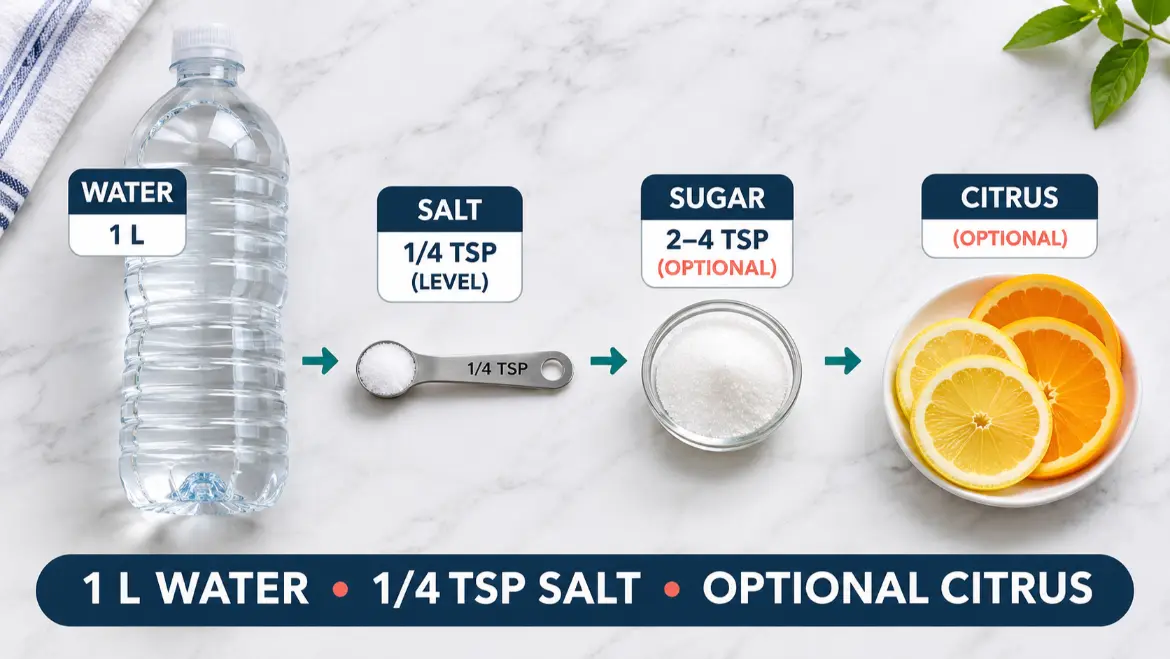
This homemade electrolyte drink is intended for a generally healthy adult after prolonged sweating. It is not a medical treatment for severe dehydration, vomiting, or diarrhea.
Simple One-Liter Electrolyte Water Recipe
- 1 liter or approximately 32–34 ounces of clean water
- 1/4 teaspoon of table salt
- 2–4 teaspoons of sugar or honey, optional for taste and carbohydrate
- 2–4 tablespoons of lemon or orange juice, optional
Stir until everything is completely dissolved. Refrigerate it if you prefer a cold drink, and prepare a fresh batch rather than repeatedly topping up an old container.
This electrolyte water recipe supplies water, sodium, chloride, and a small amount of carbohydrate if sugar is included. Citrus juice may contribute flavor and a modest amount of potassium, but that amount is not standardized.
If the mixture tastes strongly salty, check your measurements. Do not add a heaped spoonful or estimate with a large dining spoon. Measuring carefully is central to deciding how much salt to add to water for electrolytes.
Smaller 16-Ounce Version
To make approximately 16 ounces, use:
- 16 ounces water
- 1/8 teaspoon table salt
- 1–2 teaspoons sugar or honey, optional
- A squeeze of lemon or orange, optional
This smaller electrolyte drink recipe uses approximately the same concentration as the one-liter version. Avoid repeatedly drinking batch after batch simply because the ingredients seem natural.
Scaling the water and salt together is essential when deciding how much salt to add to water for electrolytes in a smaller bottle.
Medical ORS Is a Different Formula
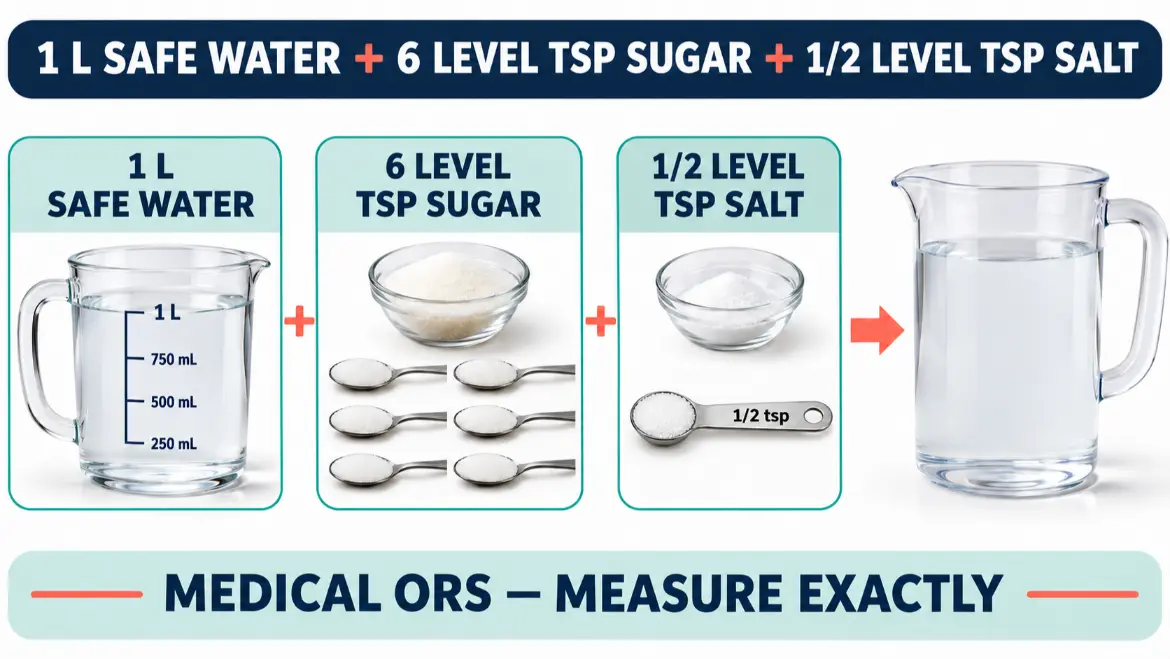
A casual workout drink and an oral rehydration solution are not interchangeable. ORS uses a controlled balance of sodium and glucose to support fluid absorption during significant gastrointestinal fluid loss.
The World Health Organization’s guidance describes a home mixture of:
- 1 liter of safe drinking water
- 6 level teaspoons of sugar
- 1/2 level teaspoon of salt
Use exact, level measurements. Too much salt can be dangerous, while too much sugar may worsen diarrhea. A properly manufactured ORS packet mixed with the stated amount of safe water is preferable when available.
This medical formula should not be used as everyday flavored water. If you are asking how much salt to add to water for electrolytes because someone has repeated vomiting, severe diarrhea, confusion, very low urine output, or cannot keep fluids down, medical guidance matters more than a general recipe.
Children, frail older adults, and people with serious illness can deteriorate quickly. Seek professional help rather than relying only on drinking salt water at home.
During illness, how much salt to add to water for electrolytes must be answered with an ORS formula—not a casual sports-drink estimate.
Salt in Water After Exercise

The need for salt in water depends on exercise duration, temperature, sweat rate, and how much sodium you already consume. Sweat losses vary widely.
White salt marks on clothing, stinging sweat, or a consistently salty taste may suggest higher sodium loss, but they do not provide an exact measurement.
For a typical gym session, water and a meal may be enough. For a long run, outdoor job, tournament, hike, or several hours of training in heat, a measured sodium-containing drink may be more useful.
When athletes ask how much salt to add to water for electrolytes, the best long-term answer may require estimating sweat rate and testing a plan during training. Race day is not the time to experiment with a much saltier drink.
Drinking too much plain water during prolonged endurance activity can also be unsafe because it may dilute blood sodium. The goal is neither maximum water nor maximum salt—it is replacing losses without greatly overdrinking.
Training conditions, sweat loss, and food intake all influence how much salt to add to water for electrolytes during long exercise.
Drinking Salt Water: Benefits and Risks
Measured drinking salt water may help replace sodium and chloride lost through hours of sweating. It may also be useful when following recognized heat-exhaustion or ORS guidance.
Unmeasured drinking salt water, however, can be unpleasant and risky. A concentrated glass may worsen thirst, nausea, or vomiting. Ocean water is far too salty for hydration and should never be used as an electrolyte drink.
Do not use salt water as a detox, cleanse, weight-loss method, constipation remedy, or substitute for medical treatment. These uses can expose someone to a large sodium dose without a clear hydration benefit.
The question how much salt to add to water for electrolytes becomes especially important for anyone with high blood pressure, kidney disease, heart failure, liver disease, swelling, or a prescribed sodium or fluid restriction.
For someone with those conditions, there may be no safe generic answer to how much salt to add to water for electrolytes. Follow personalized medical advice rather than a homemade formula.
Should You Add Sugar?
Sugar is not an electrolyte, but glucose can help the intestine absorb sodium and water in a properly formulated oral rehydration solution. During prolonged endurance exercise, carbohydrate can also provide energy.
For a casual homemade electrolyte drink, a small amount of sugar is optional. It can improve taste and provide fuel, but adding more does not automatically improve hydration. A very sweet drink may be harder to tolerate, particularly during illness.
If you simply want lightly flavored water after moderate sweating, citrus may be enough. If you need medical rehydration, use the exact ORS ratio instead of inventing a sweeter electrolyte drink recipe.
When deciding how much salt to add to water for electrolytes, make the salt decision and carbohydrate decision separately. Your body may need fluid and sodium without requiring a large sugar load.
Sugar can change taste and fuel value, but it does not determine how much salt to add to water for electrolytes.
Which Type of Salt Should You Use?
Regular table salt is the easiest choice because its fine crystals are simple to measure and it primarily consists of sodium chloride.
Kosher salt has larger crystals, so the amount that fits in a teaspoon varies by brand. Coarse sea salt creates the same measurement problem.
Pink Himalayan salt and sea salt may contain trace minerals, but those tiny amounts do not make the drink a complete electrolyte formula. The total sodium dose remains more important than the color or marketing of the salt.
For a repeatable electrolyte water recipe, use the same type of table salt and a proper measuring spoon each time. Do not substitute “a pinch” when accuracy matters.
The answer to how much salt to add to water for electrolytes is based on the measured volume of salt, not whether the front of the package says natural, mineral-rich, or premium.
Changing salt varieties without weighing them can alter how much salt to add to water for electrolytes because crystal sizes differ.
Commercial Electrolyte Options Reviewed on Electrolyte Daily
A packaged electrolyte product can be more convenient when you want consistent measurements, portability, or minerals beyond sodium and chloride. No single product is best for everyone.
LMNT: A High-Sodium Option
LMNT provides 1,000 milligrams of sodium per stick, making it a concentrated option for people with substantial sweat losses or deliberately high sodium needs.
It may be excessive for casual hydration or someone already eating a sodium-heavy diet. Read our honest LMNT review before treating one packet as equivalent to a light homemade drink.
DripDrop: Sodium Plus Carbohydrate
DripDrop Original combines sodium, potassium, magnesium, and sugar in a portable powder.
Its formula may suit travel, prolonged activity, or certain fluid-loss situations, but it should not automatically be treated as medical ORS. Our DripDrop review examines its amounts, ingredients, and value.
Ultima Replenisher: A Low-Sodium Daily Mix
Ultima Replenisher takes a different approach, with much less sodium and more emphasis on magnesium, potassium, and a broader mineral profile.
It is better positioned as a low-sodium, sugar-free daily drink than as a heavy-sweat sodium replacement. See the complete Ultima Replenisher review for its current label analysis.
Pedialyte: Illness-Oriented Rehydration
Pedialyte is designed around illness-related fluid and electrolyte replacement rather than sports flavoring alone. Different Pedialyte products have different labels, so check the exact format.
Our Pedialyte review covers the Classic ready-to-drink formula and explains its principal tradeoffs.
These products also demonstrate why how much salt to add to water for electrolytes has no universal answer. A low-sodium daily mix, a high-sodium sports packet, and an illness-oriented solution are designed for different needs.
Their contrasting labels provide useful context for how much salt to add to water for electrolytes in a homemade alternative.
How to Choose Between Homemade and Packaged Electrolytes
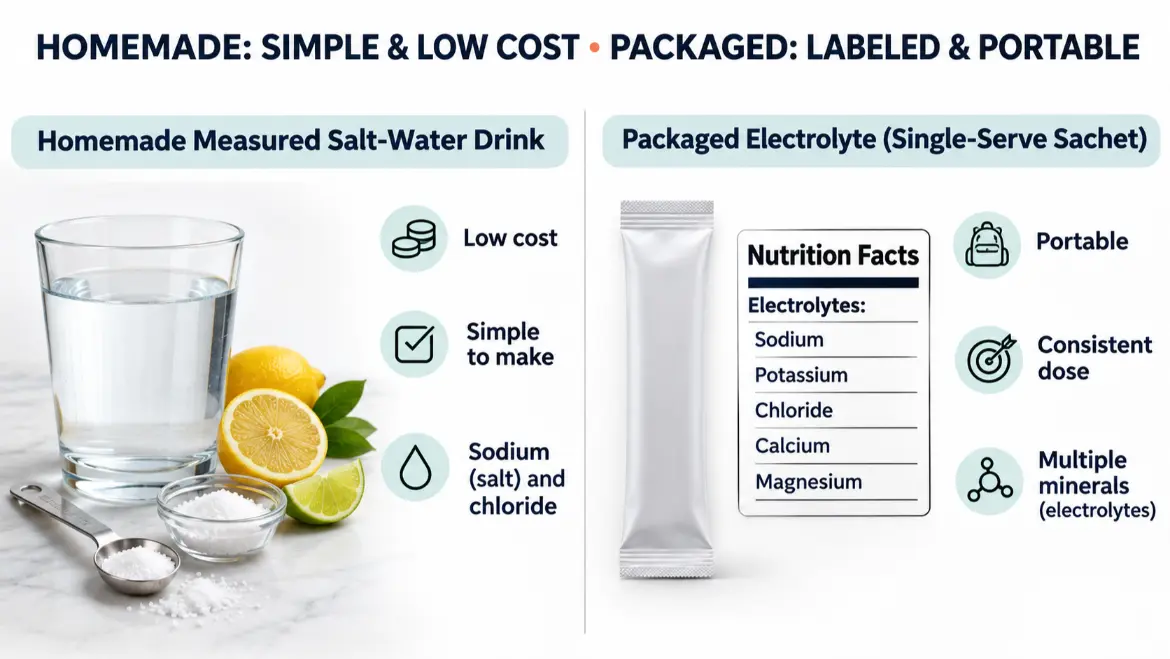
Choose a homemade mixture when you want a low-cost, simple formula and can measure accurately. It works best when sodium and fluid are the main priorities and you do not require a precisely labeled mixture of several minerals.
Choose a packaged product when you want:
- A consistent sodium amount per serving
- Potassium, magnesium, or calcium in labeled quantities
- Portable single-serve packets
- A particular sugar or sugar-free formula
- Easier preparation during travel or events
Regardless of the format, check the serving size and required water volume. Mixing a packet into eight ounces rather than sixteen does not change the total minerals consumed, but it doubles their concentration per ounce.
Concentration is a key part of how much salt to add to water for electrolytes, not merely the total salt placed in the bottle.
The same principle applies to a homemade electrolyte drink recipe. Reducing the water without reducing the salt creates a stronger drink.
Always choose the bottle volume before calculating how much salt to add to water for electrolytes.
Common Salt-Water Recipe Mistakes
Avoid these common errors:
- Using a kitchen spoon instead of a measuring spoon. Household spoons vary considerably.
- Adding a heaped measure. Recipes call for level teaspoons.
- Confusing teaspoons with tablespoons. One tablespoon is three teaspoons.
- Using coarse salt without accounting for crystal size. Volume measurements vary by salt type.
- Mixing the powder into too little water. This makes the drink unnecessarily concentrated.
- Assuming a sports recipe is medical ORS. They have different purposes and ingredient ratios.
- Ignoring food and other drinks. Total daily sodium matters.
- Making a large batch and keeping it indefinitely. Prepare fresh quantities using clean water and containers.
Preventing these mistakes is just as important as knowing how much salt to add to water for electrolytes.
Accurate measuring is what turns how much salt to add to water for electrolytes from a guess into a repeatable recipe.
When to Avoid Adding Salt
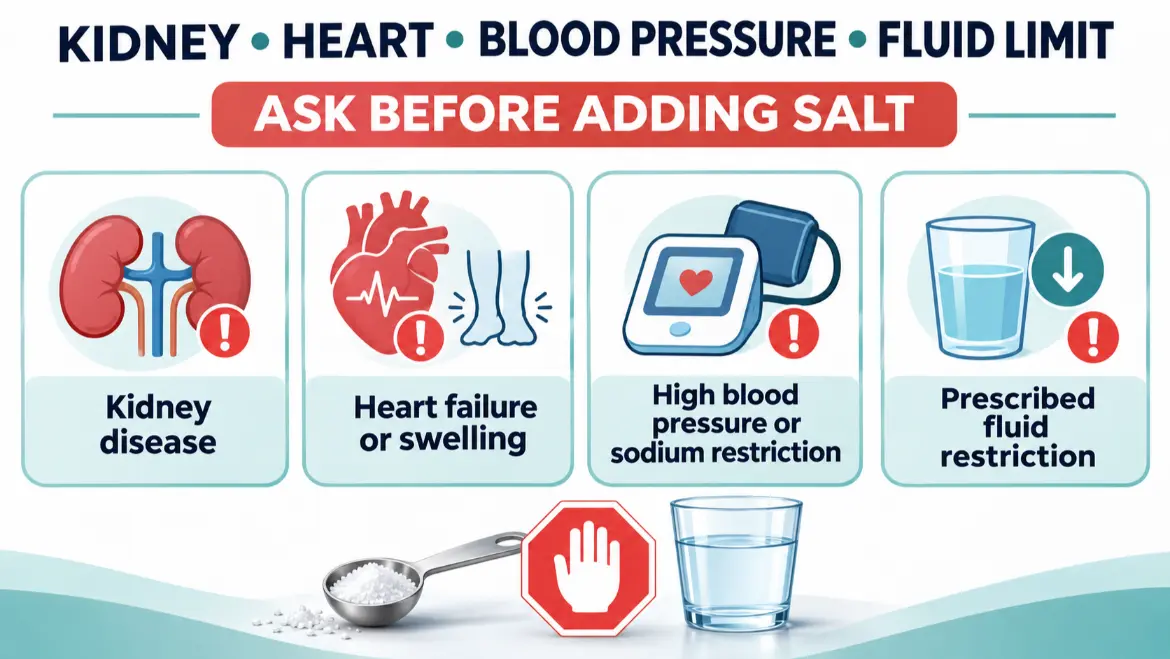
Do not routinely add salt to drinks without professional guidance if you have:
- Kidney disease or reduced kidney function
- Heart failure or significant swelling
- High blood pressure requiring sodium restriction
- Severe liver disease
- A prescribed fluid restriction
- Medicines that affect sodium, potassium, or fluid balance
- An unexplained electrolyte abnormality
Seek urgent care for confusion, fainting, seizures, severe weakness, breathing difficulty, chest pain, inability to keep fluids down, or very low urine output.
A homemade drink is not enough for severe dehydration, heat stroke, or a dangerous electrolyte disorder.
If symptoms worsen after drinking salt water, stop experimenting and obtain appropriate medical advice.
Medical restrictions can completely change the answer to how much salt to add to water for electrolytes.
The Bottom Line
So, how much salt to add to water for electrolytes? For prolonged sweating or heat-related fluid loss in an otherwise healthy adult, approximately 1/4 teaspoon of table salt per liter of water is a sensible lower-end starting point.
CDC heat-exhaustion guidance allows 1/4 to 1/2 teaspoon per liter, depending on the situation.
For ordinary daily hydration and many short workouts, add no salt—water and regular meals are usually enough.
For illness-related dehydration, use a properly prepared ORS packet or the recognized formula of one liter safe water, six level teaspoons sugar, and half a level teaspoon salt when packets are unavailable.
Measure carefully, consider sodium from the rest of your diet, and do not assume saltier means more hydrating.
Ultimately, how much salt to add to water for electrolytes depends on why fluid is being replaced and whether extra sodium is genuinely needed.
Frequently Asked Questions
How Much Salt Should I Put in 16 Ounces of Water for Electrolytes?
Using the lower-end concentration of one-quarter teaspoon per liter, approximately one-eighth teaspoon of table salt in 16 ounces of water provides similar strength. This is generally unnecessary for routine hydration.
Is a Pinch of Salt in Water Enough for Electrolytes?
A pinch is not a standardized measurement. It may add flavor and a small amount of sodium, but it cannot produce a repeatable electrolyte water recipe. Use measuring spoons when the amount matters.
Can I Drink Salt Water Every Day?
Most healthy people already obtain enough sodium through food. Daily salt water may unnecessarily increase sodium intake, especially without prolonged sweating or another clear reason for replacement.
Is Sea Salt Better Than Table Salt for an Electrolyte Drink?
No clear hydration advantage comes from sea salt. Both primarily provide sodium and chloride. Fine table salt is easier to measure consistently.
Does Lemon Water With Salt Count as an Electrolyte Drink?
It supplies water, sodium, and chloride, plus small amounts of nutrients from lemon. Whether it replaces meaningful losses depends on the measured salt amount, water volume, and situation.
Can I Use a Homemade Electrolyte Drink for Diarrhea?
A casual sports recipe is not appropriate for significant diarrhea. Use properly prepared ORS and seek medical advice for severe symptoms, blood in the stool, confusion, very low urine output, or inability to keep fluids down.
Is Drinking Salt Water Dangerous?
Concentrated or excessive salt water can be harmful. Never use seawater, salt-water cleanses, or unmeasured spoonfuls as hydration methods.
This article contains affiliate links. If you purchase through our links, we may earn a commission at no extra cost to you. We only recommend products we genuinely believe in. Read our Affiliate Disclaimer for full details.