
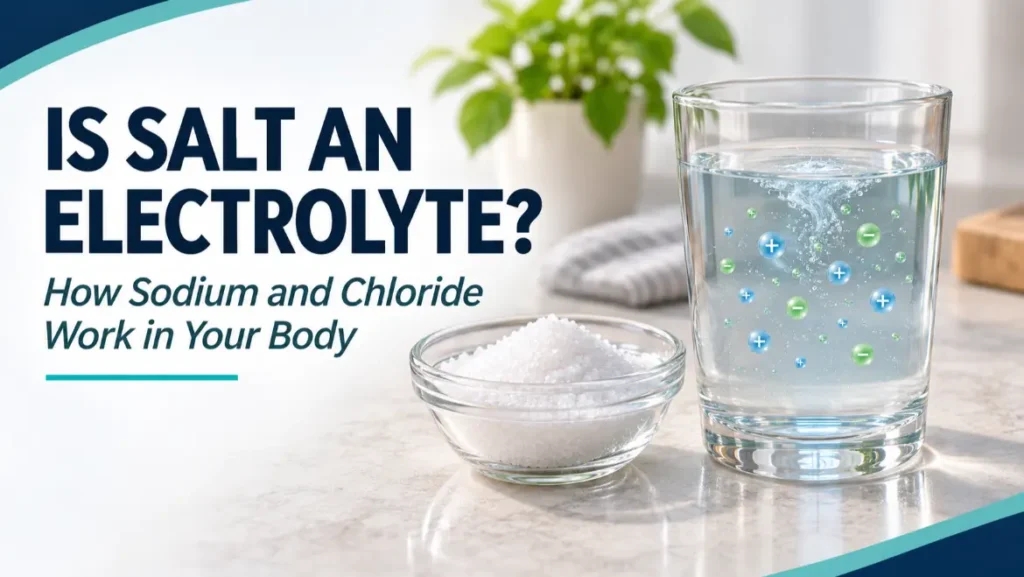
Yes, salt is an electrolyte source. Ordinary table salt is sodium chloride. When it dissolves in water, it separates into sodium and chloride ions—two essential electrolytes involved in fluid balance, nerve signaling, and muscle function. However, salt does not provide every electrolyte, and most people do not need to add extra salt to every drink.
Table of Contents
The question is salt an electrolyte sounds simple, but the most accurate answer needs one small distinction: salt is a compound that supplies electrolytes after it dissolves. It is not a complete electrolyte blend by itself.
That distinction matters when you are choosing a hydration drink, recovering after heavy sweating, or trying to understand a nutrition label. Salt may be useful in the right situation, but more is not automatically better.
Why Salt Counts as an Electrolyte Source
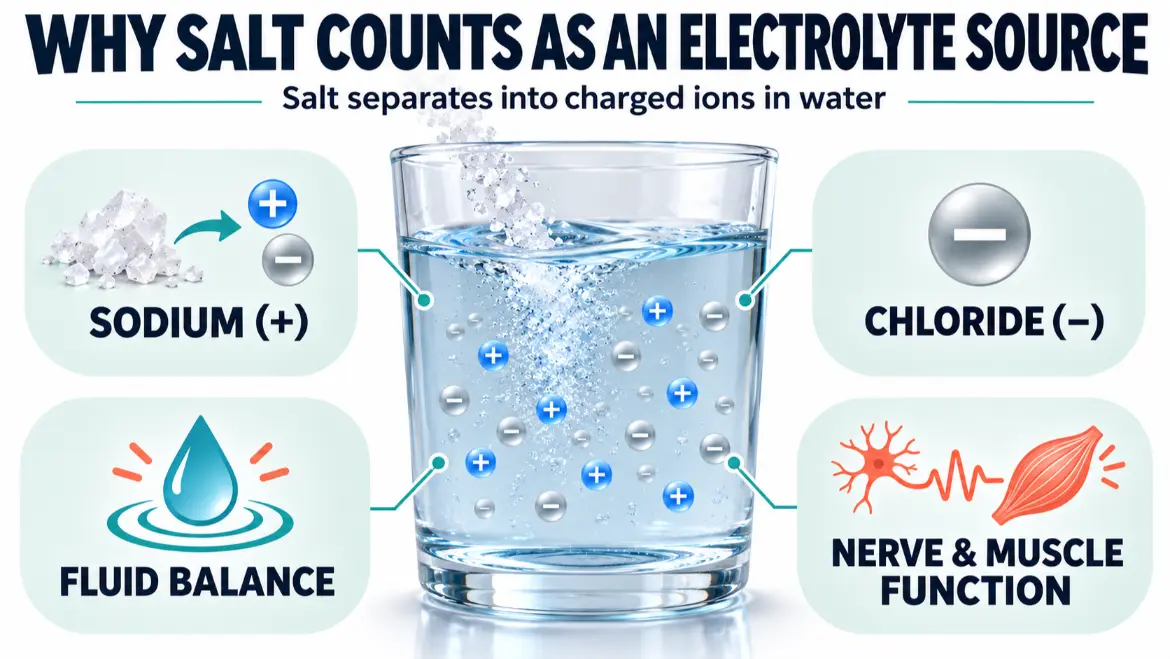
Table salt is chemically known as sodium chloride. In its dry crystal form, the sodium and chloride are joined together. Add the salt to water, and it separates into positively charged sodium ions and negatively charged chloride ions.
Electrolytes are substances that form charged particles when dissolved in water or body fluids. Because dissolved salt produces charged sodium and chloride ions, the practical answer to is salt an electrolyte is yes.
The National Cancer Institute’s electrolyte definition explains that an electrolyte breaks into electrically charged particles called ions when dissolved. That is exactly what happens to sodium chloride in water.
Sugar behaves differently. It dissolves, but its molecules do not separate into charged ions. For a clear comparison, read Is Sugar an Electrolyte?. A drink can contain both sugar and electrolytes, but the sugar itself is not the electrolyte.
Sodium and Chloride Have Different Jobs
Although they enter the body together in table salt, sodium and chloride perform distinct roles.
- Sodium helps regulate fluid balance and supports nerve impulses and normal muscle function.
- Chloride helps maintain fluid balance, blood volume, and the body’s acid-base balance. It is also a component of stomach acid.
This is why the answer to is salt an electrolyte is more useful when phrased as: salt supplies two electrolytes. It does not supply meaningful amounts of potassium, magnesium, calcium, phosphate, or bicarbonate.
Does Salt Help With Hydration?

Salt can support hydration when you have lost both water and sodium, especially through prolonged or heavy sweating. Sodium helps the body retain fluid and contributes to the movement of water and nutrients across cell membranes.
If you are asking is salt an electrolyte because you feel thirsty after exercise, remember that replacing fluid is still essential. Salt cannot rehydrate you without enough water.
That does not mean salty water is the ideal everyday beverage. For ordinary daily activity, most healthy people can generally replace their needs through regular food and water. The benefit of extra sodium depends on how much you sweat, how long you exercise, the weather, your diet, and your health.
The NIH Office of Dietary Supplements notes that most healthy people replenish everyday electrolyte losses through food and water. Electrolyte drinks may be more useful during exercise or physical work lasting longer than about an hour, or during extended exposure to hot and humid conditions.
If you want to compare options rather than simply adding salt to water, our guide to the best electrolyte drink explains how formulas differ in sodium, potassium, sugar, and intended use.
When Salt May Be Useful
Asking is salt an electrolyte often comes from a practical concern: “Should I consume more salt?” Extra sodium may be worth considering when you:
- Exercise hard for an extended period
- Sweat heavily or notice salty residue on your clothing
- Work outside in hot or humid weather
- Need to replace fluid after substantial sweat loss
- Have received a specific sodium or rehydration plan from a healthcare professional
The amount needed varies widely. A light workout in an air-conditioned room is not the same as a two-hour run in summer heat. Body size, sweat rate, acclimatization, diet, and individual sweat sodium concentration all affect your needs.
Knowing is salt an electrolyte helps explain why sodium appears in endurance products, but it does not determine the correct dose for every athlete.
When Water and Normal Meals May Be Enough
For a short, low-intensity workout or an ordinary day, water plus a balanced diet is often sufficient. Many common foods already contain sodium, and packaged or restaurant meals can contain a great deal of it.
Using an electrolyte powder simply because salt is an electrolyte may add sodium you do not need. It may also add sugar, sweeteners, or other minerals depending on the product.
Match the drink to the situation rather than assuming every activity requires a sports hydration formula.
Is Salt Water a Complete Electrolyte Drink?
No. Salt water provides sodium and chloride, but a complete hydration product may also include potassium, magnesium, calcium, carbohydrates, flavoring, or other ingredients. The formula depends on what the product is designed to do.
In other words, is salt an electrolyte and “is salt water a complete electrolyte drink?” are two different questions. The first answer is yes; the second is no.
The answer to is salt an electrolyte should not be confused with “salt is all the body needs.” Different electrolytes cannot always substitute for one another. Potassium, magnesium, and calcium have their own roles, and adding more sodium does not correct every electrolyte imbalance.
A homemade glass of salted water also lacks the controlled taste and measured serving size of a labeled product. Too much salt can make a drink unpleasant, increase sodium intake quickly, and cause nausea in some people.
Improvised recipes are especially inappropriate for treating significant dehydration caused by vomiting or diarrhea.
Salt Water Is Not the Same as Oral Rehydration Solution
Medical oral rehydration solution, commonly called ORS, is made with carefully measured amounts of water, sodium, glucose, and other ingredients. The glucose and sodium work together to support absorption in the intestine.
Even though the answer to is salt an electrolyte is yes, that fact alone is not enough to create a safe medical rehydration formula at home.
Randomly mixing salt and sugar into water is not equivalent to a standardized ORS formula. A mixture that is too concentrated can be unsafe, particularly for children or people who are already ill.
Follow a recognized recipe from a health authority or use a properly labeled product when medical rehydration is needed.
If you are comparing everyday drinks rather than medical solutions, Does Lemonade Have Electrolytes? explains why the electrolyte content depends on the ingredients rather than the drink’s name.
Salt vs. Sodium: They Are Not the Same Measurement
People often use “salt” and “sodium” as though they mean the same thing. They are related but not identical.
Understanding this difference makes the question is salt an electrolyte easier to apply when reading food and supplement labels.
Salt is sodium chloride by weight—approximately 40% sodium and 60% chloride. Nutrition labels list sodium in milligrams, not the total weight of salt. Therefore, 1,000 milligrams of salt does not equal 1,000 milligrams of sodium.
This difference is important when comparing electrolyte packets. A product showing 500 milligrams of sodium contains more than 500 milligrams of sodium chloride or other sodium-containing ingredients.
The question is salt an electrolyte may appear on a label in another form. Ingredients such as sodium citrate, sodium bicarbonate, potassium chloride, and magnesium citrate can also supply electrolytes even when the word “salt” is not prominent on the front of the package.
How to Read an Electrolyte Label
Use the Nutrition Facts or Supplement Facts panel rather than relying on words such as “hydration” or “electrolyte” on the front.
When a package makes you wonder is salt an electrolyte, look at both its ingredient list and the declared milligrams of sodium per serving.
Check these details:
- Serving size: A packet may be intended for 16, 20, or 32 ounces of water.
- Sodium per serving: This can range from very low to more than 1,000 milligrams in some products.
- Other electrolytes: Look for potassium, magnesium, calcium, and chloride.
- Sugar and carbohydrates: These may be useful during long endurance activity but unnecessary for some everyday users.
- Number of servings: A bottle or scoop may contain more than one serving.
People who deliberately want less sodium can start with lower-sodium electrolyte drinks and compare the label with their personal requirements.
Can You Have Too Much Salt?
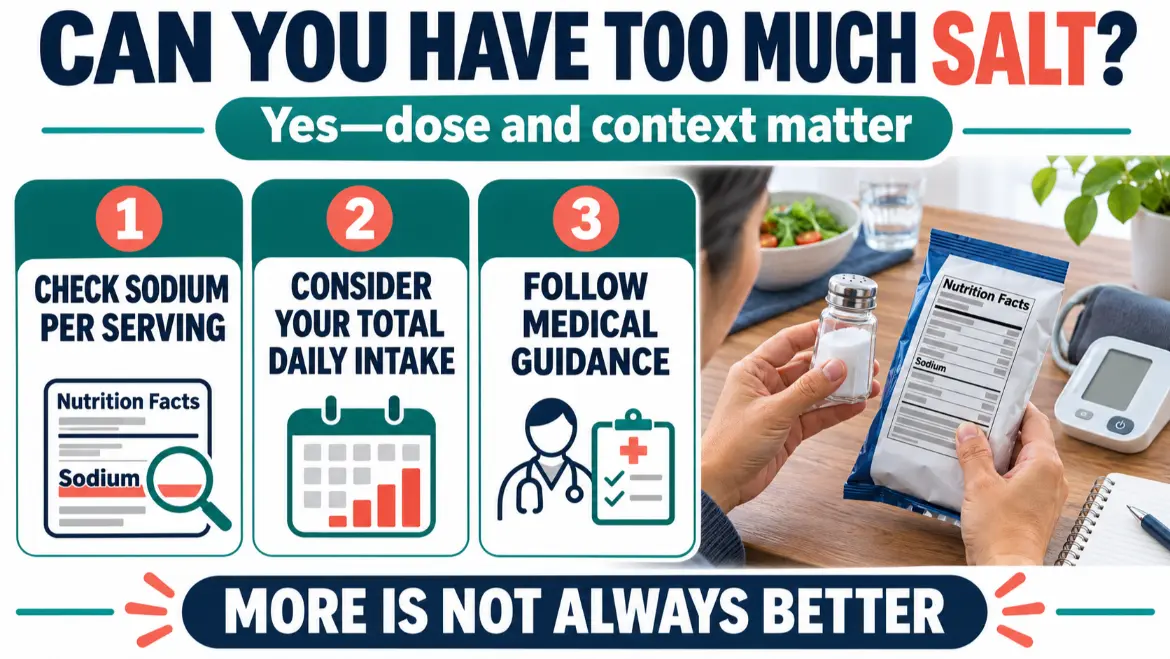
Yes. Salt is necessary, but excessive sodium intake can raise blood pressure in many people and may increase cardiovascular risk. The fact that the answer to is salt an electrolyte is yes does not turn unlimited salt into a healthy choice.
The better follow-up to is salt an electrolyte is whether the amount is appropriate for your diet, activity, climate, and health status.
The FDA’s sodium guidance states a Daily Value of less than 2,300 milligrams of sodium for adults and children four years and older. That is a general daily reference, not a personalized sports-hydration target.
People with high blood pressure, kidney disease, heart failure, fluid-retention problems, or a prescribed sodium restriction should ask a healthcare professional before increasing salt or using high-sodium electrolyte products.
Some medicines can also affect fluid and electrolyte balance.
Signs That Require Medical Advice
Do not try to correct a suspected electrolyte disorder by guessing how much salt to consume.
Seek medical advice for persistent vomiting or diarrhea, confusion, fainting, severe weakness, seizures, irregular heartbeat, significant swelling, or symptoms of serious dehydration.
Electrolyte levels can be too high or too low, and the symptoms may overlap. Blood tests—not taste, cravings, or online formulas—are used to diagnose a true electrolyte imbalance.
Does Sea Salt Have More Electrolytes Than Table Salt?
Sea salt and table salt both primarily contain sodium chloride. Sea salt may contain trace minerals, but the amounts are usually too small to make it a complete electrolyte supplement.
If the question is simply is salt an electrolyte, both sea salt and table salt qualify as sources of sodium and chloride once dissolved.
Table salt may contain iodine, an essential nutrient added to help prevent iodine deficiency. Sea salt is not necessarily iodized.
The sizes and shapes of the crystals also differ. A teaspoon of coarse sea salt may weigh less than a teaspoon of fine table salt, even though both are mostly sodium chloride.
So, is salt an electrolyte only if it is a special type such as sea salt? No. Regular table salt, kosher salt, and sea salt all supply sodium and chloride.
The meaningful differences are crystal size, flavor, processing, iodine content, and how much you consume.
Does Pink Salt Provide Better Hydration?
Pink Himalayan salt contains trace amounts of several minerals, which can affect its color. However, it remains predominantly sodium chloride.
Those trace minerals do not reliably provide the balanced or substantial electrolyte amounts found in a measured hydration formula.
The answer to is salt an electrolyte does not change because the crystals are pink. Color does not prove a meaningful hydration advantage.
If you prefer its flavor, you can use it as a culinary salt. It should not be treated as a uniquely powerful hydration supplement.
For hydration purposes, the total sodium dose and overall formula matter more than the salt’s color or marketing story.
Is Salt an Electrolyte in Sports Drinks?
Sports drinks may use sodium chloride, sodium citrate, or other sodium salts. Once dissolved, these ingredients supply charged ions.
Manufacturers choose different forms to adjust sodium content, flavor, acidity, and how the drink feels in the mouth.
Therefore, is salt an electrolyte in a sports drink? Yes, when the formula contains sodium or potassium salts that separate into ions.
However, two sports drinks can have dramatically different electrolyte amounts. The word “electrolyte” alone does not tell you whether a product fits your needs.
Endurance athletes and very salty sweaters may prefer a higher-sodium option, while casual users may want a moderate or low-sodium drink.
People who consume plenty of sodium through meals should consider their full daily intake rather than evaluating the drink in isolation.
The Bottom Line
So, is salt an electrolyte? Salt is best described as a source of the electrolytes sodium and chloride.
When salt dissolves in water, it separates into charged ions that help regulate body fluids and support normal nerve and muscle function.
Salt may help replace sodium lost through prolonged or heavy sweating, but it is not a complete electrolyte blend and is not necessary in every glass of water.
Most people already obtain sodium from food, and excessive intake can be harmful.
Use the situation, nutrition label, your total diet, and any medical guidance to decide whether extra sodium makes sense. “Electrolyte” describes an important function—not permission to consume unlimited salt.
Frequently Asked Questions
Is salt an electrolyte or a mineral?
Salt is a compound made from the minerals sodium and chloride. When dissolved, it separates into sodium and chloride ions, so it functions as an electrolyte source.
Is sodium the same as salt?
No. Sodium is one component of salt. Table salt is sodium chloride and is approximately 40% sodium by weight. Nutrition labels report sodium, not the total weight of salt. This is why answering is salt an electrolyte does not mean the terms “salt” and “sodium” should be used as identical measurements.
Can I add salt to water for electrolytes?
Adding salt supplies sodium and chloride, but the correct amount depends on the situation. For everyday hydration, food and plain water may be enough. Do not use an improvised salt mixture to treat serious dehydration.
Is salt an electrolyte when it is dry?
Dry salt contains the ingredients that form electrolytes, but its sodium and chloride ions become mobile and able to conduct current after the salt dissolves in water or body fluid.
Does all salt contain electrolytes?
Table salt, kosher salt, and sea salt all primarily contain sodium chloride and supply sodium and chloride ions in water. Trace-mineral content varies, but none should be assumed to provide a complete electrolyte profile.
Is salt the most important electrolyte after sweating?
Sodium is often the electrolyte lost in the greatest quantity through sweat, but individual losses vary. Fluid replacement and the duration, intensity, and temperature of the activity also matter.
Do I need an electrolyte drink every day?
Most healthy people can cover ordinary electrolyte needs with food and water. A specialized drink may be more useful after prolonged exercise, heavy sweating, or activity in hot conditions.
Why do people ask, “Is salt an electrolyte?”
Salt is discussed in both hydration and blood-pressure advice, which can sound contradictory. The key is dosage and context: sodium and chloride are essential, but excessive sodium is not beneficial.
This article contains affiliate links. If you purchase through our links, we may earn a commission at no extra cost to you. We only recommend products we genuinely believe in. Read our Affiliate Disclaimer for full details.